
Heat Pump Hydronic Heating Cost Melbourne: 2026 Pricing & ROI Guide
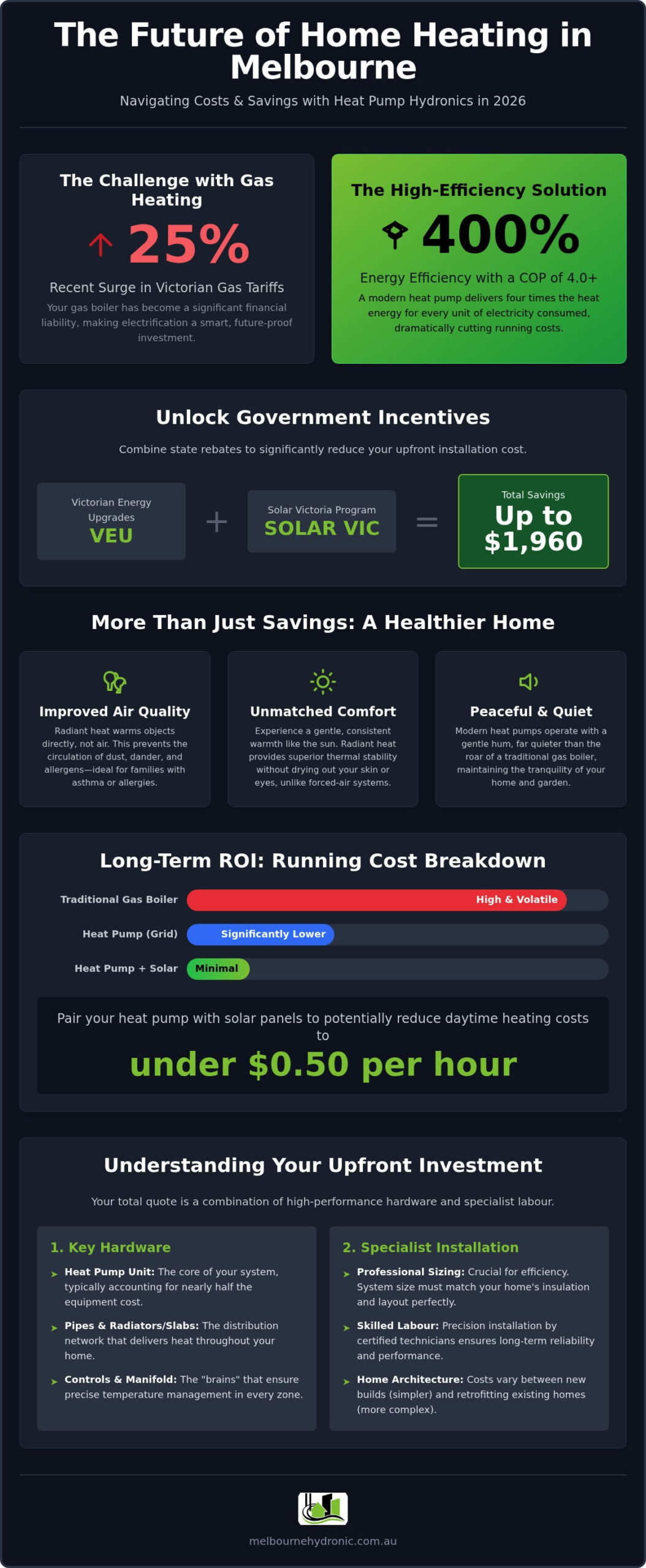
With Victorian gas tariffs surging by 25 percent recently, that high-efficiency gas boiler you once relied on has quietly become one of your home’s biggest financial liabilities. It’s completely understandable if the initial heat pump hydronic heating cost melbourne quotes have given you pause, particularly when you’re trying to figure out which 2026 rebates actually apply to your specific property. You want a home that stays perfectly warm during a damp July morning without the dread of a massive utility bill arriving in your inbox.
This guide cuts through the confusion to show you exactly how the 2026 Victorian Energy Upgrades and Solar Victoria incentives can slash your upfront investment by up to $1,960. You’ll discover the real-world ROI of switching to an all-electric system and see why a modern heat pump, maintaining a Coefficient of Performance of 4.0 or higher, is the most reliable way to secure long-term energy independence. We’ll provide a clear breakdown of running costs compared to gas and confirm how a professionally designed system ensures your family’s well-being through every damp Melbourne winter.
Key Takeaways
- Learn how to combine Victorian Energy Upgrades (VEU) and Solar Victoria incentives to secure up to $1,960 in total savings on your transition.
- Understand the total heat pump hydronic heating cost melbourne by distinguishing between a straightforward boiler-to-heat-pump swap and a complete system installation.
- Discover why a high Coefficient of Performance (COP) allows electric heat pumps to deliver four times the heat energy of traditional gas systems for every kilowatt used.
- Identify how professional system sizing and your home’s insulation levels directly impact your long-term return on investment and daily comfort.
- Explore the financial benefits of pairing your heat pump with solar panels to potentially reduce your daytime heating costs to under $0.50 per hour.
Melbourne Homeowners: Heat Pump Hydronics in 2026
Melbourne’s weather is famous for its unpredictability. One moment it’s sunny. The next, it’s a damp, bone-chilling 10 degrees. For decades, gas boilers were the standard choice for luxury warmth. As we move through 2026, the “electric boiler” or heat pump hydronic system has taken center stage. This technology acts as the heart of a modern home. It provides consistent, silent warmth without the volatility of the gas market. It’s the gold standard for those who value both environmental responsibility and premium comfort in our unique climate.
The Shift from Gas Boilers to Electric Heat Pumps
Victoria is currently leading the national push toward electrification. Gas prices have seen a recent 25 percent surge. New residential developments are moving away from gas connections entirely. Homeowners are increasingly looking at the long-term heat pump hydronic heating cost melbourne as a way to escape rising tariffs. While the hardware is a sophisticated piece of engineering, the basic principle of how heat pumps work involves moving heat from the outside air into your home. You aren’t creating heat through combustion. This makes them incredibly quiet. Unlike the roar of an old gas unit, a modern heat pump operates with a gentle hum. Your backyard remains a peaceful sanctuary. If you’re new to this technology, it helps to understand What is Hydronic Heating? before diving into the specific 2026 pricing models. Gas is rapidly becoming a legacy fuel in Victoria. Choosing an electric alternative is the best way to future-proof your property value.
While this guide focuses on Victorian homes, the shift to electric is a national trend; for those managing larger commercial or industrial facilities, check out Metro Electric for expert electrical design and maintenance.
Health and Comfort: The Non-Monetary “Costs”
Beyond the utility bills, there’s a vital health dimension. It often gets overlooked in basic quotes. Traditional split systems rely on fans to move hot air. This inevitably stirs up dust, pet dander, and allergens. It’s a significant concern for the many Melbourne families living with asthma or seasonal allergies. Radiant heat is different. By using hydronic radiator panels or underfloor piping, the system warms the room through electromagnetic waves. It doesn’t rely on aggressive air movement. This keeps the air still and clean. It prevents the circulation of irritants. Radiant efficiency is the ability of a system to heat the physical objects and people in a room rather than just the air between them. It feels like the gentle warmth of the sun. It won’t dry out your skin or eyes. It provides a level of thermal stability that air-based systems simply can’t match. For local families, this improved indoor air quality is a return on investment that pays dividends in well-being every single day.
Breaking Down the Upfront Installation Costs in Melbourne
When you look at a quote for a new system, it’s easy to focus solely on the bottom line. However, the total heat pump hydronic heating cost melbourne homeowners encounter is actually built on three distinct pillars: the heat pump unit itself, the distribution network of pipes and panels, and the specialised labour required for a precise installation. Understanding how these elements interact helps you see your heating system as a long-term asset rather than just another appliance purchase. Whether you’re planning a “boiler swap” to replace an ageing gas unit or a complete “full install” for a new property, every component plays a role in your home’s future efficiency.
Hardware vs. Labour: Where the Money Goes
The heat pump unit is the most significant hardware investment. It typically accounts for nearly half of the total equipment cost. We often recommend Tier 1 European or premium local units because they’re engineered to handle Melbourne’s damp, cold winters without losing efficiency. Beyond the unit, you’re also investing in high-quality insulated pipework. This is vital in Victoria to prevent heat loss as water travels through sub-floor spaces or roof cavities. The manifold and control systems also represent a portion of the budget. These “brains” of the system ensure that every room reaches its target temperature exactly when you need it. By taking advantage of Victorian heat pump rebates, you can often offset a portion of these initial hardware costs, making the transition to electric much more manageable.
New Builds vs. Retrofitting Existing Melbourne Homes
The complexity of your home’s architecture is a major factor in labour hours. New builds are generally more cost-effective from a labour perspective. Builders can lay underfloor piping or install radiator lines while the frame is open and the slab hasn’t been poured. Retrofitting an established home requires a different level of expertise. Melbourne’s iconic double-storey Victorian terraces in suburbs like Carlton or Fitzroy present unique challenges. Accessing floor joists or navigating heritage brickwork takes time and precision. This is where the “access factor” comes into play. If your home has a generous sub-floor or accessible roof cavity, the installation is more straightforward. A professional site audit is the best way to identify these variables early. It helps you avoid “hidden” plumbing costs and ensures the system is sized perfectly for your home’s specific heat loss profile. If you’re ready to see how these factors apply to your property, our team can help you design a system tailored to your home’s layout.
Running Costs vs. Gas: The Long-Term ROI for Victorian Homes
The true value of an appliance isn’t found on the price tag; it’s found on your monthly utility bill. In the current 2026 energy market, the heat pump hydronic heating cost melbourne residents face is significantly lower than traditional gas alternatives. This is primarily due to the Coefficient of Performance, or COP. While a gas boiler is, at best, 90 to 95 percent efficient, a modern heat pump typically operates at a COP of 4.0. This means for every 1 unit of electricity the system consumes, it delivers 4 units of heat into your home. You’re essentially gaining 3 units of heat for free from the ambient air.
Pairing this efficiency with Melbourne’s high solar uptake creates what we call “Solar Synergy.” If you run your heat pump during the day while your solar panels are active, your running costs can drop below $0.50 per hour. Even without solar, the recent 25 percent surge in Victorian gas tariffs makes electricity the more stable financial choice. When you consider the broader electrification of your home, including the Solar Victoria hot water rebate, the cumulative savings over a 15-year lifecycle are substantial. Unlike gas boilers that require frequent combustion-related servicing, heat pumps have fewer moving parts and no volatile fuel source, leading to lower long-term maintenance expenses.
Calculating Your Break-Even Point
To find your ROI, you need to look at your total energy spend. We provide a framework that compares your current annual gas consumption with the projected kilowatt-hours an electric system will use. The secret to a quick break-even point is professional system sizing. A system that’s too large will cycle on and off too frequently, wasting energy. A system that’s too small will struggle to reach temperature. Our design-led approach ensures your hardware matches your home’s specific heat loss. For a deeper look at the technical specifications that drive these savings, you can explore our guide on Heat Pump Hydronic Heating.
The Impact of Melbourne’s Climate on Efficiency
There’s a common myth that heat pumps fail when the temperature drops. In reality, modern units feature advanced defrost cycles designed specifically for damp, chilly climates. Melbourne’s winters are actually ideal for this technology because our temperatures rarely stay below freezing for long periods. A high-end heat pump reaches its peak efficiency at an ambient temperature of approximately 7°C, which happens to be a very common winter morning temperature in suburbs like Geelong or Berwick. This means your system is performing at its absolute best exactly when you need it most, ensuring your heat pump hydronic heating cost melbourne remains predictable even during the coldest months of the year.
Factors That Influence Your Specific Melbourne Quote
Every home tells a different story when it comes to thermal performance. A modern 6-star energy rated home in Geelong requires far less energy to maintain a comfortable temperature than a drafty, high-ceilinged villa in Camberwell. This thermal efficiency directly dictates the size of the heat pump unit you need. It is a primary driver of the heat pump hydronic heating cost melbourne homeowners see on their initial quotes. Understanding these variables is the only way to get an accurate picture of the investment required for your specific renovation or new build.
The choice of emitters also shapes the final budget. While some clients prefer the invisible luxury of underfloor heating, others find that radiator panels offer the best balance of performance and installation speed. Beyond the physical hardware, the complexity of your zoning plays a role. If you want independent temperature control for every bedroom and living area, the additional thermostats and manifold actuators will add to the total. We also see many families opting for domestic hot water integration. While this increases the upfront cost, having one high-efficiency unit handle both your space heating and your tap water is a smart way to maximise your Victorian rebates and streamline your home’s energy footprint.
Radiators vs. Underfloor: Impact on the Bottom Line
The choice between underfloor heating and radiator panels is one of the most significant budget decisions. Underfloor systems are incredibly efficient and comfortable. However, they are generally best suited for new slabs where the pipes can be laid before the concrete is poured. For the majority of Melbourne renovations, Hydronic Radiator Panels are the preferred choice. They provide the same high-quality radiant warmth with much less disruption to your existing flooring. You can also mix and match your emitters. You might choose designer towel rails for the bathroom and standard panels for the bedrooms to balance cost and style perfectly.
The Importance of Heat Loss Calculations
Relying on a “rule of thumb” for system sizing is a risky and often expensive strategy. At Melbourne Hydronic Heating, we move beyond basic estimates. We use specialised software to perform detailed heat loss calculations. This process involves looking at your window orientations, wall insulation types, and even the local wind exposure of your specific suburb. This precision ensures you don’t overspend on an oversized unit you don’t need. It also guarantees that your home remains a sanctuary even when the temperature outside drops toward zero. A smaller, correctly-sized heat pump is cheaper to buy and significantly more efficient to run than a generic, oversized alternative. If you want to understand how these factors apply to your property, you can request a professional design consultation with our local experts.
Navigating 2026 Rebates and Choosing Your Specialist
Securing a fair heat pump hydronic heating cost melbourne quote is only half the battle. To truly maximise your investment, you need to navigate the 2026 rebate landscape effectively. In Victoria, the government has intensified its push toward electrification. They offer substantial incentives through the Victorian Energy Upgrades (VEU) program. These discounts are applied at the point of sale by an accredited provider. This means you don’t have to wait months for a refund. Additionally, federal Small-scale Technology Certificates (STCs) act as a form of currency for renewable energy. Most reputable installers calculate these certificates and deduct them directly from your final quote. This lowers your upfront capital requirement before the first pipe is even laid.
Choosing a specialist with local Melbourne expertise is vital for technical reasons too. We understand the “Solar Sponge” effect. This involves configuring your system to work with Victorian grid requirements. It allows you to soak up excess solar energy during the middle of the day when the grid is under less pressure. A local expert also knows how to handle the specific water chemistry and climatic challenges of the Port Phillip Bay region. As the industry grows to meet electrification demands, many leading firms are focusing on business building for electricians to ensure high-quality service delivery. Before you sign a contract, use this final checklist to vet your provider:
- Do they have at least a decade of specific hydronic experience?
- Are they a Registered Provider for the VEU and Solar Victoria schemes?
- Do they provide a detailed heat loss calculation or just a basic estimate?
- Is there a local support team for ongoing servicing and maintenance?
Maximising Victorian Government Incentives
To claim your 2026 rebates, you’ll generally need proof of your combined household taxable income. As of July 1, 2026, this limit is $150,000 per year. You’ll also need your property’s council rates notice and proof of any existing gas appliances being decommissioned. The “Gas-to-Electric” incentive is a specific highlight for Melbourne and Geelong residents. It provides a higher rebate value for those actively removing gas boilers. Always confirm your installer’s credentials before work begins. A non-registered provider could cost you thousands in lost government support.
Why a Design-First Approach Saves You Money
There’s a significant difference between a “box-dropper” and a design-and-build specialist. A box-dropper simply installs a unit and leaves. A specialist looks at the entire thermal envelope of your home. We’ve built a 30-year legacy as a family-owned business by focusing on this technical precision. Our design-led approach ensures your system sizing is perfect. This prevents the mechanical wear and tear that leads to premature failure. Choosing a local expert means you have support long after the installation is complete. It’s about safety, reliability, and the peace of mind that comes from knowing your family’s comfort is in expert hands. If you’re ready to start your transition, you can request a professional design and cost estimate for your Melbourne home.
Securing Your Home’s Future Comfort
Transitioning to an all-electric home is no longer just a sustainability goal; it’s a practical financial strategy for 2026. By understanding the heat pump hydronic heating cost melbourne homeowners face, you can move away from volatile gas prices and toward a system that pays for itself through superior efficiency. Combining state and federal rebates can significantly lower your initial investment, while professional system sizing ensures your running costs remain predictable for the next 15 years.
At Melbourne Hydronic Heating, we bring over 30 years of experience to every project. We specialise in energy-efficient heat pump technology and provide local Geelong and Melbourne service support to ensure your system performs at its peak. Our team focuses on technical precision to improve your family’s well-being and long-term comfort. If you’re ready to see how these benefits apply to your specific property, we’re here to help you take the next step toward energy independence.
Get a Custom Heat Pump Hydronic Quote for Your Melbourne Property
Investing in your home’s comfort today ensures a cleaner, warmer, and more cost-effective environment for your family for years to come.
Frequently Asked Questions
How much does it cost to replace a gas boiler with a heat pump in Melbourne?
Replacing a gas boiler involves decommissioning the old unit and integrating a new electric system into your home’s plumbing. The total heat pump hydronic heating cost melbourne families encounter depends on whether you’re performing a straightforward hardware swap or upgrading your entire distribution network. Because every property has unique access challenges and thermal requirements, a professional site audit is the only way to determine the exact scope of your project.
Are there Victorian government rebates for hydronic heat pumps in 2026?
Yes, eligible Victorian households can access significant financial incentives in 2026 through the Solar Victoria and Victorian Energy Upgrades (VEU) programs. These rebates can total up to $1,960 when combined, provided you use a registered provider. These discounts are typically applied at the point of sale, which helps to lower your initial capital investment and speeds up your total return on investment.
How much can I save on my energy bills by switching to electric hydronic heating?
Homeowners can typically expect to reduce their annual energy bills by 25 to 30 percent after switching from a traditional gas boiler. This significant saving is driven by the heat pump’s high efficiency and the recent 25 percent surge in Victorian gas tariffs. If you pair your system with a solar array, your daytime running costs can drop even further, often falling below $0.50 per hour.
Is a heat pump powerful enough for a large, old Melbourne home?
Modern heat pumps are more than capable of heating large, older Melbourne homes when the system is designed specifically for the property’s unique heat loss profile. We use professional software to model your home’s thermal envelope before installation. This ensures the unit is powerful enough to maintain consistent, sun-like warmth even in high-ceilinged Victorian terraces or drafty weatherboard villas during the peak of winter.
What is the average lifespan of a hydronic heat pump compared to a gas boiler?
A high-quality hydronic heat pump typically has an operational lifespan of 15 to 20 years with regular maintenance. This compares favourably to traditional gas boilers, which often begin to lose significant efficiency after 10 to 12 years. Because heat pumps move heat rather than creating it through combustion, they experience less internal mechanical stress and wear over their decade-long lifecycle.
Does a hydronic heat pump provide domestic hot water as well?
Yes, many modern heat pumps are designed to provide both hydronic space heating and domestic hot water for your taps and showers. This dual-purpose configuration is an excellent way to maximise your return on investment. It allows one highly efficient unit to handle all your home’s thermal needs while completely removing the need for a separate gas hot water service.
Can I use my existing radiator panels with a new heat pump system?
You can often reuse your existing hydronic radiator panels, provided they are in good condition and sized correctly for a heat pump’s lower operating temperatures. A technical assessment is essential to confirm the system’s thermal balance. Our team can evaluate your current hardware to see if it meets modern efficiency standards and integrate it into your new all-electric system.
How long does the installation of a heat pump hydronic system take?
A standard residential installation of a heat pump system usually takes between three and five days to complete. A simple boiler-to-heat-pump swap is often faster than a full system install in a new build or a complex renovation. We coordinate every stage of the process, from the initial site audit to the final commissioning, to ensure minimal disruption to your routine.