What Size Boiler Do I Need for My House in Australia? A 2026 Sizing Guide
The biggest boiler on the shelf isn’t necessarily the one that will keep your family the warmest this winter. In fact, if you’re asking, “what size boiler do I need for my house Australia,” choosing based on the “bigger is better” myth often leads to short cycling and those eye-watering energy bills you’re trying to avoid. We know that conflicting advice from general plumbers makes this decision feel high-stakes, especially when you’re investing in your home’s long-term comfort and health.
You’re right to be cautious because an accurately sized system is the true secret to a sustainable, premium lifestyle. This guide will show you exactly how to calculate the capacity required to keep every room perfectly cozy while keeping running costs low. We’ll explore the rapid shift toward electric heat pumps, explain how the 2026 gas connection bans in Victoria and Sydney impact your purchase, and provide the technical clarity you need to make a confident, expert-backed decision for your property.
Key Takeaways
- Understand why boiler “size” refers to power output in kilowatts (kW) rather than physical dimensions to ensure your home stays consistently warm.
- Identify how your home’s thermal envelope and local climate impact the answer to “what size boiler do I need for my house Australia” to avoid costly oversizing.
- Learn why transitioning from a gas boiler to an electric heat pump requires a different sizing strategy due to massive differences in energy efficiency.
- Discover how your choice between hydronic radiator panels and underfloor heating dictates the total capacity your system needs to operate effectively.
- Recognize why a professional heat load calculation is the only way to guarantee a healthy, energy-efficient system that lowers your long-term running costs.
Why Getting Your Boiler Size Right is Critical for Your Home
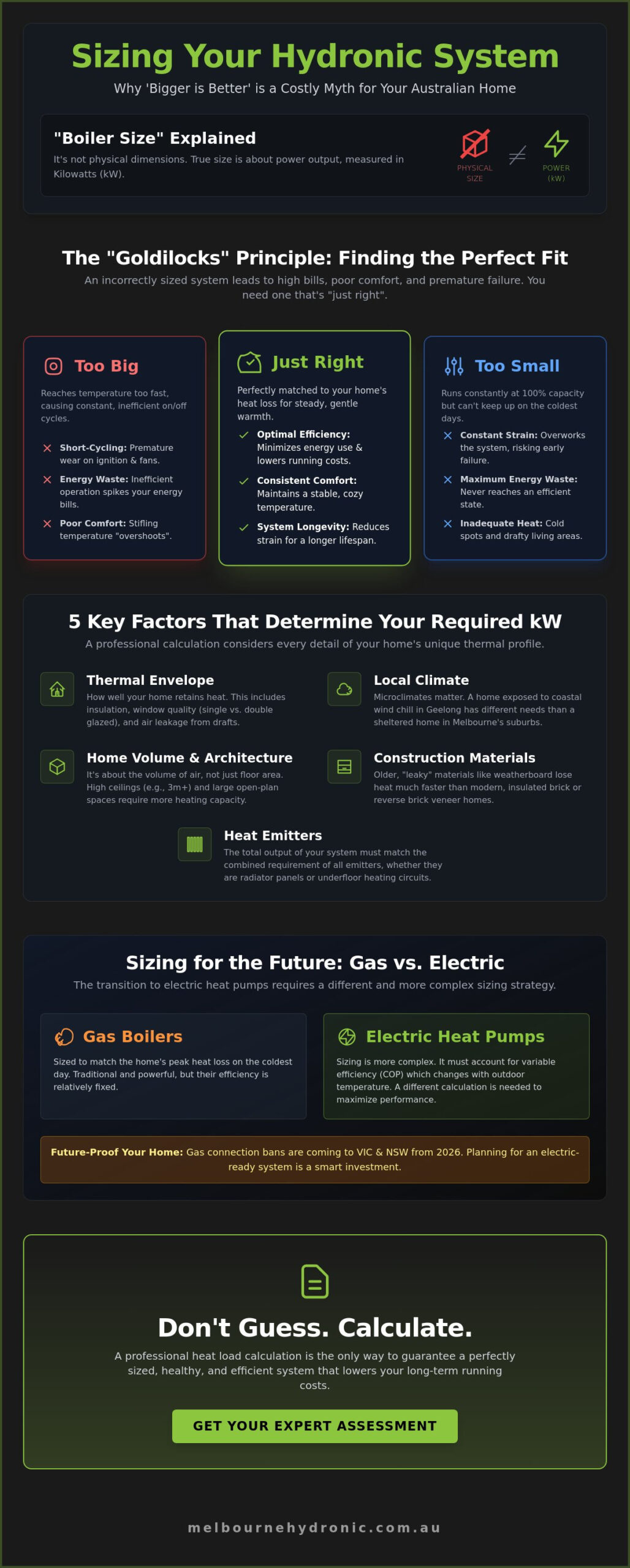
When homeowners ask, “what size boiler do I need for my house Australia,” they’re often surprised to learn that “size” has nothing to do with the physical dimensions of the unit. In the world of hydronic heating, size refers to the power output, which is measured in kilowatts (kW). Choosing the right capacity is a technical balancing act often called the Goldilocks principle. You need a system that is neither too powerful nor too weak, but perfectly matched to your home’s unique heat loss profile.
A well-designed central heating system provides more than just warmth; it offers a premium level of comfort and health. However, achieving this depends entirely on technical precision. If the kW output doesn’t match the requirements of your floor area and insulation, you’ll likely face higher energy bills and a system that fails well before its expected lifespan. Modern energy prices in Australia don’t leave much room for error, making accuracy more important than ever.
It’s also a mistake to simply check the rating on your existing, aged boiler. Older units were often installed based on “rule of thumb” estimates rather than calculated heat loads. Technology has moved forward, and 2026 standards for efficiency are far more rigorous. For homeowners globally, from West Sussex where WellPlumbed provides expert heating services to the suburbs of Melbourne, the goal remains the same: find the exact capacity that maintains a stable, healthy environment without wasting resources.
This focus on precision is a hallmark of quality service worldwide. For homeowners in the UK looking for expert support, you can visit NBS Plumbing & Heating to learn more about how specialist plumbing and heating services can ensure your system is perfectly sized for comfort and efficiency.
The Dangers of an Oversized Boiler
Many people assume that a larger boiler provides a safety net for the coldest days, but the opposite is true. When a unit is too powerful for the space it’s heating, it reaches the target temperature almost instantly and shuts down. It then restarts just as quickly when the temperature drops slightly. Short-cycling is the primary cause of early boiler failure in residential systems. This repetitive on and off process wears out the ignition components and fans prematurely. Beyond the mechanical strain, oversized units cause uncomfortable temperature “overshoots,” where the room becomes stiflingly hot before the system cuts out, destroying the gentle, consistent warmth that hydronic heating is known for.
The Struggles of an Undersized System
An undersized system is equally problematic, especially during a Melbourne cold snap. If the kW output is too low, the boiler will run at 100% capacity for hours on end without ever reaching the thermostat’s set point. This constant strain on the heat exchanger leads to massive energy waste and a noisy, overworked system. You’ll also notice the impact in specific areas; for instance, your hydronic towel rails may stay tepid, and large open-plan living areas will feel drafty and under-heated. It’s a frustrating experience that compromises your well-being and the longevity of your investment.
Key Factors Affecting Boiler Size in Australian Homes
Determining the answer to “what size boiler do I need for my house Australia” requires a deep look at your property’s thermal envelope. Unlike the heavily insulated homes found in Northern Europe, many Australian houses were built with ventilation in mind rather than heat retention. This means the construction materials and local climate play a much larger role in your sizing decision than just the number of rooms. A house that feels “drafty” is essentially a house with a high heat-loss rate, which directly dictates the kilowatts required to stay warm.
Local microclimates are a major factor in these calculations. A home in Geelong, exposed to persistent coastal wind chill, will have different heat loss characteristics than a sheltered property in Melbourne’s leafy eastern suburbs. According to the Australian Government, selecting a right sized heating system involves calculating how much heat escapes through your walls and roof during the coldest night of the year. If you skip this step, you risk buying a unit that can’t keep up when the temperature drops toward zero in the early hours of a Victorian July morning.
Modern architectural trends also influence the kW requirement. High ceilings and expansive open-plan living areas create large volumes of air that need to be heated. If your home features 3-metre ceilings or a mezzanine void, you’ll need a higher capacity boiler than a house with the same floor area but standard 2.4-metre ceilings. It’s about the volume of the space, not just the footprint on the ground.
Home Age and Construction Material
Victorian weatherboard cottages are notoriously “leaky,” often losing heat through gaps in floorboards and uninsulated wall cavities. Weatherboard loses heat faster than double brick during a Victorian winter, meaning these homes often require a higher kW output per square metre to maintain comfort. Interestingly, a modern 2026-spec new build in Melbourne often requires a significantly smaller boiler than an older, smaller cottage because of superior insulation and airtightness standards.
Window Glazing and Orientation
Windows are the weakest link in an Australian home’s thermal defense, frequently allowing heat to escape even when the rest of the wall is well-insulated. Single-pane glass can account for a massive percentage of a home’s total heat loss during winter. However, orientation matters. North-facing windows provide passive solar gain that reduces the load on your system during the day. Upgrading to double glazing can actually allow you to install a smaller, more efficient boiler or heat pump. If you’re unsure how your home’s orientation affects your needs, a professional system assessment can provide the technical clarity you need.
How to Calculate the kW Required for Your Hydronic System
Calculating the exact energy output required for your property is a methodical process that moves beyond guesswork. To accurately answer the question, “what size boiler do I need for my house Australia,” you must follow a structured sequence of calculations that account for both space and usage. While every home is unique, following these five steps provides a technical foundation for your system design.
- Step 1: Calculate total heated floor area. Measure the square metre (m²) of every room where you intend to install heating. Exclude areas like garages or storage rooms that won’t have active heat sources.
- Step 2: Identify your distribution method. Decide if you are using radiator panels, underfloor pipes, or a hybrid of both. Each method has different flow temperature requirements.
- Step 3: Apply the regional wattage rule. For the Melbourne and Geelong climate, a common rule of thumb is 100 to 150 Watts per square metre, depending on your home’s insulation quality.
- Step 4: Factor in domestic hot water. If you choose a “Combi” boiler, the unit must be powerful enough to provide instant hot water to your showers and taps while simultaneously heating the home.
- Step 5: Add a 10% safety margin. We always include a small buffer to ensure the system can comfortably handle the most extreme Victorian cold snaps without running at its absolute limit.
Radiator Panels vs. Underfloor Sizing
The way you deliver heat significantly changes the load on your boiler. Modern hydronic heating panels typically require higher water temperatures, often between 60 and 75 degrees Celsius, to radiate heat effectively. In contrast, underfloor systems operate at much lower temperatures but rely on a large thermal mass. If you’re installing a hybrid system, such as underfloor heating on the ground level and panels upstairs, the boiler must be sized to handle the higher temperature demand of the radiators while managing the longer run times required for the floor coils.
The ‘Radiator Count’ Method for Quick Estimates
For a preliminary estimate, you can use the radiator count method. Generally, you should allow 1.5kW to 2kW of boiler power for every standard-sized radiator panel in your home. This figure needs to be adjusted upward for large double convector radiators or specialized additions like hydronic towel rails. While this method is a helpful starting point for budgeting, it doesn’t replace a professional calculation. It’s a “ballpark” figure that helps you understand the scale of the unit you might need before a technician performs a detailed heat load assessment.
Gas Boilers vs. Electric Heat Pumps: Sizing Differences
As the Australian energy market shifts toward electrification, the way we calculate system capacity has fundamentally changed. When asking, “what size boiler do I need for my house Australia,” it’s vital to recognize that gas kilowatts and heat pump kilowatts are not interchangeable. A traditional gas boiler might be rated at 30kW to handle both heating and instant hot water, but an heat pump hydronic heating system providing the same level of comfort might only require a 12kW to 16kW unit. This is because heat pumps are significantly more efficient, often operating at 300% to 400% efficiency by moving heat rather than creating it through combustion.
Sizing for electric systems also requires accounting for low-temperature operation. While a gas boiler can blast high-temperature water into radiators regardless of the weather, a heat pump’s output can fluctuate based on the outdoor air temperature. In colder regions like Ballarat or the Yarra Valley, the system must be sized to ensure it delivers enough warmth even when the mercury drops. Additionally, large-scale electric installations in older Melbourne suburbs may require a review of the property’s electricity grid capacity, as high-output heat pumps can sometimes necessitate three-phase power upgrades.
Sizing an Electric Heat Pump
The efficiency of a heat pump is measured by its Coefficient of Performance (COP). A COP of 4.0 means for every 1kW of electricity used, 4kW of heat is delivered. Because heat pumps are most efficient when running for longer periods at lower temperatures, they are sized much closer to the home’s actual heat load than gas units. To prevent the system from short-cycling during milder weather, we often integrate buffer tanks. These tanks act as a thermal battery, allowing the heat pump to operate steadily and efficiently even in smaller Melbourne homes with varying zone demands.
Gas Boiler Replacement Considerations
Despite the push for electric, a high-efficiency gas boiler remains a powerful solution for large, poorly insulated heritage homes that require high water temperatures. Modern condensing boilers are far superior to older models, capturing waste heat from exhaust gases to achieve efficiencies around 90%. When planning a replacement, consider if the unit can be part of a future hybrid system. This allows you to keep the reliability of gas for peak winter periods while eventually integrating a heat pump for sustainable base-load heating. If you’re ready to upgrade your home’s efficiency, contact our expert team for a tailored sizing assessment.
Why a Professional Heat Load Calculation is Essential
Relying on a basic online tool to answer “what size boiler do I need for my house Australia” is a gamble with your home’s long-term comfort. While digital calculators provide a convenient starting point, they rarely account for the subtle technical variables that define a high-performance system. A professional heat load assessment, often following the rigorous Australian Standard or ‘Manual J’ methodology, is the only way to ensure your investment delivers the premium warmth you expect. This process involves a room-by-room analysis that considers every possible point of heat loss.
At Melbourne Hydronic Heating, we’ve spent 30 years refining these calculations across thousands of local properties. We know that a heritage house in the Dandenongs requires a different approach than a modern, airtight townhouse in Richmond. Paying for a professional design isn’t just about technical compliance; it’s about achieving a high return on investment through lower monthly energy bills and a system that operates silently for decades. When a boiler is perfectly matched to the load, it avoids the mechanical stress of constant cycling, which means fewer repairs and a much cleaner operation. This precision is what separates a basic utility from a true lifestyle upgrade.
The Melbourne Hydronic Consultation Process
Our experts look beyond simple square meterage to build a complete thermal profile of your property. We examine your home’s specific orientation to the sun, the thickness of your ceiling insulation, and even the air leakage around older door frames. We also match the boiler’s output to your actual lifestyle. If you have guest rooms that remain unused for months, we can design a zoned system that provides heat only where it’s needed, preventing unnecessary energy waste. This level of detail ensures your installation meets all Victorian plumbing and gas safety regulations while maximizing your family’s personal well-being and health.
Next Steps for Your Melbourne Home
If you’re currently preparing for a hydronic heating service melbourne or looking for a new installation quote, it helps to have your floor plans and any insulation details ready. When speaking with installers, don’t be afraid to ask how they calculated the kW rating and what the warranty coverage looks like for both the unit and the labor. A professional should be able to explain exactly why they chose a specific capacity based on your home’s unique weak spots, such as large single-glazed windows or uninsulated floorboards. Taking these steps now prevents the headaches of an unevenly heated home later.
Book your expert consultation with Melbourne Hydronic Heating today to secure a warm, energy-efficient, and sustainable future for your family.
Secure Your Home’s Future Comfort with Precision Sizing
Finding the right answer to what size boiler do I need for my house Australia is about more than just matching numbers on a chart. It involves understanding your property’s unique thermal envelope and making an informed choice between traditional gas systems or modern, energy-efficient heat pump conversions. As we’ve explored, the correct kilowatt output is the foundation of lower running costs and a healthier, more consistent living environment for your family.
At Melbourne Hydronic Heating, we bring over 30 years of local experience to every installation. As a family-owned and operated business, we’re specialists in helping homeowners navigate the technical shift toward sustainable heating. You don’t have to guess your way to a cozy winter. Let our experts provide the technical precision you need for a lifetime of quiet, reliable, and premium comfort.
Get a Professional Heat Load Calculation & Quote from Melbourne Hydronic
Frequently Asked Questions
What size boiler do I need for a 3 bedroom house in Australia?
A typical 3 bedroom house in Australia generally requires a gas boiler with a capacity between 18kW and 24kW. However, the exact answer to what size boiler do I need for my house Australia depends heavily on your home’s insulation quality and ceiling height. If you’re switching to an electric heat pump, the required kilowatts are often much lower, usually ranging from 9kW to 12kW, due to their superior efficiency in moving heat.
Is a 30kW boiler too big for a small house?
A 30kW boiler is usually too large for a small house if it’s only used for hydronic heating. While a 30kW combi boiler might be necessary to provide high-flow domestic hot water for showers, it’s often overkill for heating the living spaces. An oversized unit causes short-cycling, where the system turns on and off rapidly, leading to component wear and inconsistent indoor temperatures.
Does a bigger boiler use more gas or electricity?
Yes, a larger boiler often consumes more energy because it operates less efficiently than a correctly sized unit. When a system is too powerful for the space, it can’t modulate its output low enough to match small heating demands. This results in wasted fuel during frequent start-up cycles and higher utility bills compared to a system that’s precisely matched to your home’s heat loss.
How do I know if my current boiler is the wrong size?
You can identify a sizing issue by observing your system’s behavior during a cold snap. If the boiler turns on and off every few minutes even when it’s freezing outside, it’s likely oversized. On the other hand, if the unit runs constantly at maximum capacity but your radiators stay tepid and the rooms never reach the thermostat’s set point, the system is undersized.
Can I use a combi boiler for my underfloor heating?
You can use a combi boiler for underfloor heating, but the installation requires technical precision. Because underfloor systems operate at much lower water temperatures than radiators, a mixing valve is essential to prevent damage to your floor surfaces. The boiler must also be sized to handle the long, steady run times required to heat a concrete slab’s significant thermal mass.
What is the most common boiler size for Melbourne homes?
The most common gas boiler size for average Melbourne homes is between 24kW and 30kW, particularly for combi models that provide both heating and hot water. For homeowners transitioning to sustainable electric heat pumps, units in the 11kW to 16kW range are the standard for typical three-to-four-bedroom residential properties across the Victorian region.
Does the number of bathrooms affect my hydronic boiler size?
The number of bathrooms only impacts the boiler size if you’re using a combi system that provides domestic hot water. If your boiler is dedicated solely to hydronic radiator panels or underfloor coils, the bathroom count doesn’t matter. For combi units, more bathrooms require a higher kW rating to ensure consistent water pressure and temperature when multiple taps are running simultaneously.
Should I size my boiler for future home extensions?
It’s practical to plan for future extensions, but you shouldn’t drastically oversize the unit for your current needs. Most modern boilers have wide modulation ranges that can adapt to slightly larger loads later. If you’re planning a significant renovation within the next two years, it’s better to choose a system that offers flexibility or can be part of a future hybrid setup.