

Boiler Replacements Melbourne: The 2026 Homeowner’s Guide & Checklist
Is your 15-year-old heating unit silently draining A$450 extra from your annual budget while posing a hidden safety risk to your family? Many Melbourne residents are currently facing the same dilemma as winter temperatures drop and gas prices climb. You likely value the silent, dust-free comfort of hydronic heat, but the uncertainty surrounding Victorian gas connection policies and the fear of carbon monoxide leaks from aging units can be overwhelming. It’s time to trade that anxiety for the reliability of modern engineering.
We understand that upgrading your home’s infrastructure is a significant decision. This guide simplifies **boiler replacements** for 2026, showing you how to access the latest energy-efficient technology and secure available Victorian energy rebates to offset your costs. You’ll learn exactly how a high-efficiency condensing boiler can reduce your energy consumption by 28% while maintaining a healthy, allergy-friendly environment. We’ve compiled a comprehensive checklist to ensure your new system meets every current safety standard and provides the premium, quiet warmth your Melbourne home deserves.
Key Takeaways
- Identify the critical 15-20 year performance milestone and learn how rising winter gas bills signal the need for a high-efficiency system upgrade.
- Compare the long-term benefits of gas condensing units versus modern electric heat pumps to choose the best technology for your boiler replacements.
- Avoid common sizing mistakes by learning why a “like-for-like” swap may fail and how to assess if your existing pipework can handle modern pressure.
- Navigate the latest 2026 Energy Safe Victoria (ESV) regulations and discover how to claim significant A$ rebates through the Victorian Energy Upgrades (VEU) scheme.
- Understand the professional “Clean Installation” process that ensures a dust-free, allergen-friendly transition to a more sustainable and silent heating solution.
Signs Your Melbourne Home Needs a Boiler Replacement
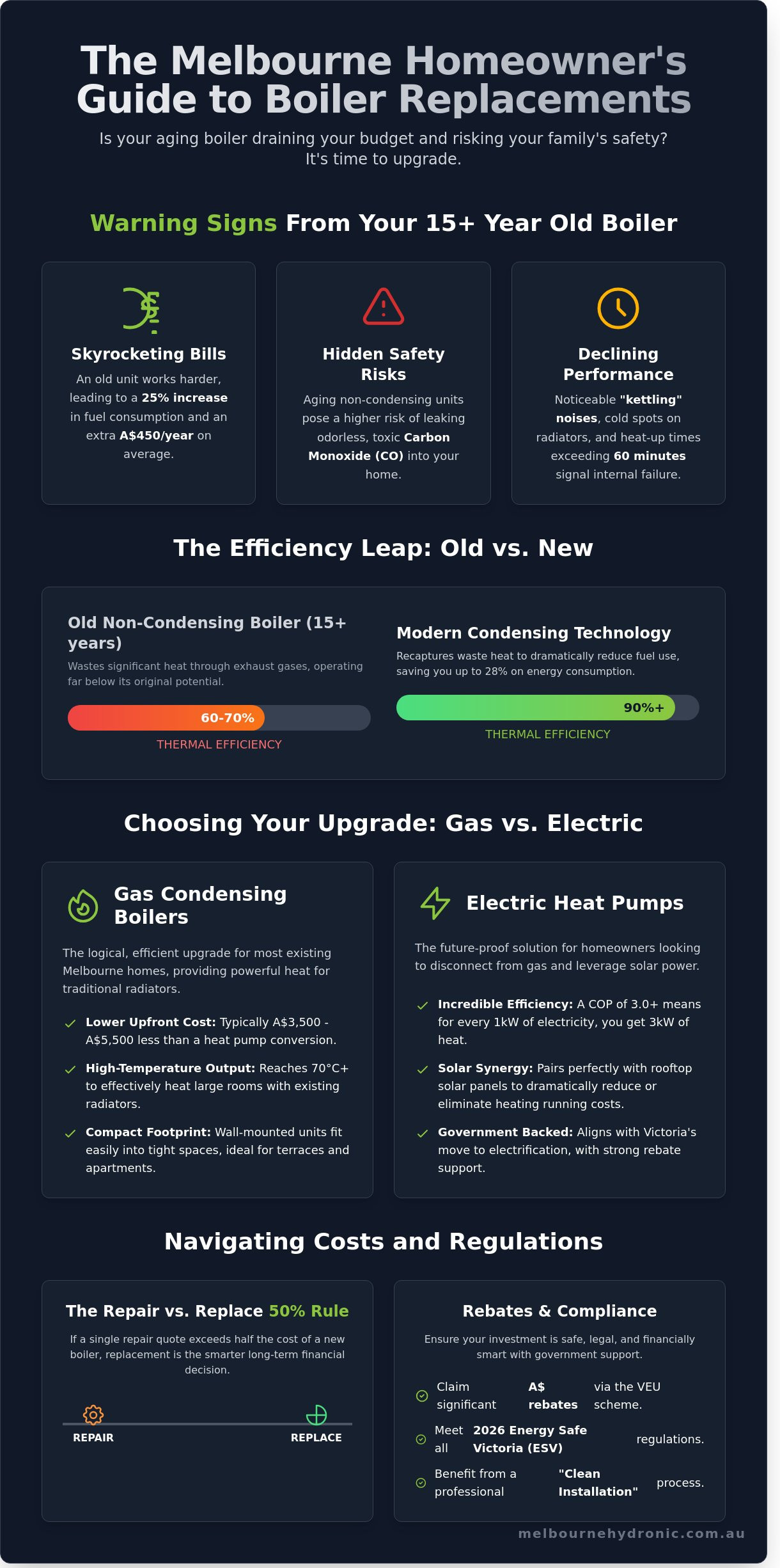
Most hydronic systems in Melbourne reach their performance peak between 15 and 20 years. If your unit was installed before 2010, it’s likely approaching the end of its reliable service life. While these systems are built for longevity, the internal components eventually succumb to mineral build-up and thermal stress. You’ll notice this first in your winter gas bills. An aging boiler works harder to achieve the same ambient temperature, often leading to a 25% increase in fuel consumption compared to its first decade of operation.
Understanding how central heating works helps identify why these components fail; as water circulates through the heat exchanger, limescale can accumulate. This leads to “kettling,” a distinct banging or whistling sound that signals your heat exchanger is struggling. More importantly, older non-condensing units pose a higher risk of carbon monoxide leaks. In Melbourne, where we rely heavily on sealed heating during sub-10-degree mornings, ensuring your system doesn’t leak odorless, toxic gases is a non-negotiable safety priority for your family’s health.
Performance Red Flags to Watch For
System degradation often starts with small, annoying inconsistencies. If you find cold spots on radiator panels even after bleeding the air, the pump might be failing or sludge has built up. Frequent pressure drops that require you to manually top up the system via the filling loop indicate a leak or a ruptured expansion vessel. During a typical Melbourne July morning, a healthy system should reach peak temperature within 20 to 30 minutes. If yours takes over an hour, the system’s efficiency has likely plummeted.
The “Repair vs Replace” Financial Threshold
We generally advise the 50% rule: if a single repair quote exceeds half the cost of a new unit, investment in boiler replacements is the smarter financial move. This is especially true for discontinued European brands where parts are now scarce, often requiring expensive air-freight from overseas. Modern condensing boilers can improve your home’s energy efficiency by up to 30%. This transition not only lowers your monthly A$ gas spend but also ensures a dust-free, allergen-friendly environment that older, struggling units cannot maintain. Choosing boiler replacements before a total mid-winter breakdown also saves you the premium costs of emergency call-outs during the July peak season.
Choosing Your Upgrade: Gas Condensing vs. Electric Heat Pumps
Deciding on the right technology for your boiler replacements depends on your home’s existing infrastructure and your 2026 energy goals. Melbourne homeowners now face a clear choice between refined gas technology and the rapid shift toward electrification. Each system offers distinct advantages for the Victorian climate, particularly when you factor in the state’s evolving energy regulations and the January 2024 ban on gas connections for new homes.
High-efficiency gas condensing boilers remain the most logical “like-for-like” swap for most established homes in suburbs like Camberwell or Malvern. These units capture heat from exhaust gases that older, non-condensing models simply wasted. This process pushes thermal efficiency levels above 90%, which is a massive jump from the 60% or 70% efficiency seen in units installed fifteen years ago. They provide the high-temperature water needed to get the best performance out of traditional, smaller steel panel radiators.
Electric energy-efficient heat pumps represent the modern alternative for those looking to disconnect from the gas grid entirely. These systems extract ambient heat from the outside air to warm your hydronic circuit. While some worry about performance in Victoria’s damp winters, modern air-to-water heat pumps are engineered to handle Geelong and Bayside frosts with ease. They maintain a Coefficient of Performance (COP) of 3.0 or higher even when the morning temperature sits at a crisp 5°C. This means for every 1kW of electricity used, you get 3kW of heat delivered into your home.
The Gas Condensing Advantage
- Lower Upfront Investment: Initial capital outlay is typically A$3,500 to A$5,500 less than a full electric heat pump transition.
- High-Temperature Output: These units easily reach 70°C, ensuring older radiator panels can still heat large rooms effectively during a mid-July cold snap.
- Compact Footprint: Wall-mounted gas boilers are roughly the size of a kitchen cupboard, making them the only viable option for narrow inner-city terraces with zero garden space.
The Case for Electric Heat Pumps
- Solar Synergy: Pairing a heat pump with an existing 6.6kW or 10kW solar PV system allows you to pre-heat your home using “free” daytime energy.
- Future-Proofing: With gas prices in Victoria rising by 20% to 30% in recent cycles, switching to electric protects you from volatile fossil fuel markets.
- Health and Air Quality: Moving to an all-electric setup removes combustion from the home, contributing to a cleaner environment and supporting the dust-free, allergen-friendly benefits hydronic heating is famous for.
Space requirements often dictate the final decision for boiler replacements in 2026. A gas boiler sits discreetly on an internal or external wall. In contrast, a heat pump requires an external fan unit and often a large thermal buffer tank, needing roughly 2 to 3 square meters of clear outdoor space. If you’re unsure which system fits your backyard or balcony, our team can provide a professional site assessment to measure your available footprint.
The Pre-Installation Checklist for Melbourne Homeowners
Upgrading your heating isn’t a simple swap. It’s a precision engineering project. Many homeowners assume a “like-for-like” swap is best, but if you’ve added a 20-square-metre extension or installed double-glazed windows since 2018, your heating load has changed. A 30kW boiler might now be overkill, leading to short-cycling that wastes 15% of your energy. We calculate the exact heat loss of every room to ensure your new system runs at peak efficiency.
Your existing infrastructure must also meet 2026 standards. We check if your 30-year-old copper pipes can withstand the 2.5 bar pressure of a modern sealed system. Older open-vented systems operated at much lower pressures. If the pipes are brittle, they’ll leak under the new load. We also mandate a full power flush. Removing magnetite sludge can improve heat transfer by 12% and is required by manufacturers like Baxi or Immergas to validate your 10-year warranty. Without it, your new boiler replacements are at risk of premature pump failure.
Location is the final hurdle. Victorian Gas Safety Regulations require specific flue clearances. For example, a fan-assisted flue must be at least 300mm from an opening window. If we can’t meet these distances, we’ll suggest a vertical plume kit through the roof to stay compliant with Energy Safe Victoria (ESV) mandates.
Technical Site Assessment
- Gas Line Diameter: Modern high-output condensing boiler replacements often require a 25mm or 32mm gas supply. Your old 20mm line will cause “starvation” and system lockout during peak winter nights.
- Electrical Capacity: If you’re opting for a hybrid heat pump upgrade, your switchboard needs a dedicated 20A or 32A circuit. We check if your board has RCD protection as per AS/NZS 3000 standards.
- Condensate Discharge: Condensing boilers produce roughly 2 litres of mildly acidic liquid per hour. We identify a PVC drain point that won’t freeze or corrode your garden beds.
Local Climate Considerations
Melbourne’s microclimates dictate the hardware we choose. In Bayside suburbs like Brighton or the Mornington Peninsula, salt-laden air corrodes standard steel units within 5 years. We specify C5-M rated corrosion-resistant casings here. For residents in the Dandenong Ranges, where temperatures hit -2°C, we integrate glycol-based anti-freeze and trace heating to prevent external pipe bursts. If you’re in the Melbourne CBD, we ensure external fans stay below the 45dB(A) night-time noise limit set by local council bylaws to keep your neighbours happy and your home peaceful.
Melbourne Regulations, Permits, and Energy Rebates in 2026
Navigating the regulatory environment for boiler replacements in 2026 requires a precise understanding of Victorian safety standards and evolving environmental mandates. Energy Safe Victoria (ESV) maintains strict requirements for all gas appliance installations, focusing on ventilation and pressure management. If your current system predates 2016, it likely fails current safety benchmarks. The Victorian Building Authority (VBA) acts as the statutory body overseeing the plumbing industry, ensuring that every technician performing a replacement is licensed and that the installation adheres to the state’s rigorous building codes.
A VBA Compliance Certificate is a non-negotiable document for any plumbing work valued at A$750 or more, including labor and materials. This certificate serves as your legal proof that the installation meets Australian Standards; without it, most home insurance providers will reject claims related to fire, water damage, or system failure. Additionally, federal incentives in 2026 now offer low-interest financing through the Clean Energy Finance Corporation for residential upgrades that achieve a minimum 25% improvement in energy performance compared to the outgoing model. Many homeowners planning a full heating upgrade also find it valuable to review the hot water installation cost across Melbourne and Geelong to budget accurately for all connected system components.
Securing Your Rebates
The Victorian Energy Upgrades (VEU) scheme has shifted its focus heavily toward decarbonization. Homeowners can currently access rebates for high-efficiency heat pump integrations, which often reduce upfront costs by A$900 to A$1,200. To claim these incentives, you must engage an “Accredited Provider” recognized by the Essential Services Commission. You’ll need to provide documentation including the Certificate of Compliance, the decommissioning record of your old unit, and a calculated energy savings report generated by your installer to prove the efficiency gains meet the 2026 threshold.
Compliance and Safety Standards
All boiler replacements must strictly follow the AS/NZS 5601.1 technical standard. This code governs everything from gas pipe sizing to flue terminal locations, ensuring the system operates without risk to the household. Following the physical installation, your plumber must perform mandatory carbon monoxide spillage testing. This step is critical for maintaining a healthy, dust-free indoor climate, particularly for families concerned with respiratory health. Since 1 January 2026, these safety test results must be uploaded to the ESV online portal before the job is officially signed off.
Adherence to these standards is supported by using genuine, high-quality automation equipment. For professionals sourcing such components in Australia, specialist suppliers like InstroDirect are a key resource.
Protect your home and maximize your energy savings by choosing a certified specialist for your boiler replacements today.
The Melbourne Hydronic Replacement Process
Choosing the right partner for your heating upgrade ensures that your investment delivers the silent, allergen-friendly warmth your family deserves. Our process begins with a professional design consultation. We don’t just swap units; we calculate the specific heat load of every room to ensure your new heat source is perfectly sized for your home’s unique footprint. This precision prevents short-cycling and extends the life of your equipment.
We take our “Clean Installation” promise seriously. Our technicians use specialized drop sheets and protective coverings to shield your floors and furniture from any dust or debris. Since we specialize in hydronic systems, we understand that maintaining the pristine condition of your Melbourne residence is just as important as the technical success of the install. You’ll find your home exactly as you left it, only significantly warmer.
Step-by-Step Installation Day
- Decommissioning: We safely disconnect your old unit and handle the eco-friendly disposal of all components. We ensure heavy metals and recyclable parts are processed correctly rather than heading to a landfill.
- System Power Flushing: Before the new unit starts, we perform a deep system flush. This removes the “sludge” and magnetite buildup that often plagues older pipes, protecting your new investment from day one.
- System Commissioning: Our team balances every radiator to ensure even heat distribution. This 120-minute process ensures there are no cold spots in your living areas.
- User Training: We’ll walk you through your new smart thermostat and mobile app. You’ll leave the session confident in managing your home’s climate from your phone.
Why Local Expertise Wins
Melbourne’s architectural diversity, from Victorian terraces in Carlton to modern builds in Brighton, requires a nuanced approach to boiler replacements. We’ve spent 30 years refining our craft specifically within these local conditions. This deep history allows us to provide ongoing support and maintenance that generic plumbing services simply can’t match.
Our long-standing partnerships with premium European brands like Baxi, Immergas, and Rehau ensure you receive hardware built to last 25 years or more. These systems are engineered for high efficiency, often reducing gas consumption by up to 30% compared to units installed in the early 2000s. If you’re ready to upgrade your comfort, you can book a professional boiler assessment for your Melbourne home today. We bring three decades of engineering precision to every project, making boiler replacements a seamless experience for your household.
Secure Your Home’s Warmth for the 2026 Season
Transitioning to a high-efficiency system isn’t just about staying warm; it’s about future-proofing your property against rising energy costs and evolving Victorian regulations. Whether you opt for a modern gas condensing unit or a sustainable electric heat pump, the right choice ensures a quieter, more reliable home environment. You’ll enjoy a dust-free heating experience that’s specifically designed to be allergy-friendly, removing the respiratory irritants often found in traditional ducted systems.
Melbourne Hydronic Heating brings 30+ years of local expertise to every installation. As Victorian Building Authority (VBA) licensed specialists, we guarantee that your project adheres to the strictest safety and performance standards. Modern boiler replacements can reduce your annual energy consumption by up to 30% compared to aging, non-condensing units. We focus on delivering premium European technology tailored specifically for the unique demands of the Melbourne climate. For comprehensive guidance on choosing the best hydronic boiler for your Melbourne home, our detailed 2026 homeowner’s guide covers everything from European engineering standards to local climate considerations. It’s time to invest in a system that prioritizes both your comfort and your health. Book Your Melbourne Boiler Replacement Consultation today to start your journey toward a more efficient, luxuriously warm home.
Frequently Asked Questions
How much does a boiler replacement cost in Melbourne in 2026?
A standard boiler replacement in Melbourne in 2026 typically costs between A$5,800 and A$9,500 including professional installation. High efficiency condensing units or complex retrofits can push this investment toward A$12,000. These figures cover the unit, labor, and necessary pipework adjustments. We’ve seen a 4% annual increase in equipment costs since 2024, so locking in a quote early helps manage your budget effectively.
How long does it take to replace a hydronic boiler?
Most boiler replacements are completed within 1 to 2 business days. If you’re swapping an old gas unit for a similar modern model, our team usually restores your heat in under 8 hours. Complex projects involving system flushes or relocating the unit can extend to 3 days. We prioritize your comfort by ensuring your home stays clean and dust free during the transition.
Can I swap my gas boiler for an electric heat pump without changing my radiators?
You can swap a gas boiler for an electric heat pump, but 70% of existing Melbourne radiators require upgrading to larger sizes to maintain warmth. Heat pumps operate at lower temperatures, around 45 to 55 degrees Celsius, compared to the 75 degrees produced by gas. We assess your current panel radiators to ensure they provide enough surface area for efficient, allergen friendly heating without the need for gas.
Do I need a permit to replace my boiler in Victoria?
Yes, you must receive a VBA Compliance Certificate for any plumbing work in Victoria valued over A$750. This document proves your installation meets AS/NZS 5601.1 safety standards and protects your home insurance policy. Our licensed technicians lodge this paperwork within 5 days of completing your installation. This gives you permanent proof of professional compliance and safety for your records.
Is a condensing boiler significantly better than a standard one?
Condensing boilers are 25% more efficient than standard models because they capture heat from exhaust gases that otherwise escape through the flue. This technology achieves 92% to 98% efficiency ratings, whereas older non condensing units often struggle to reach 80%. Switching to a condensing model reduces your annual energy bills by roughly A$350 while providing a quieter, more environmentally responsible heating solution for your family.
What is the best time of year to replace my boiler in Melbourne?
The best time for boiler replacements in Melbourne is between October and February. Getting the job done during the warmer months means you can enjoy popular local activities, like getting out on the water with a service such as Boat4Hire, without worrying about being without heat when the temperature drops in July. You’ll also find shorter wait times for our expert installers, as demand peaks by 40% once the first cold snap hits in late April.
What happens to my old boiler once it is replaced?
We remove and recycle your old boiler as part of our comprehensive service. Approximately 95% of a traditional cast iron or copper boiler is recyclable, which reduces the impact on Melbourne’s landfills. Our team hauls the unit away immediately after the new installation is finished. This leaves your utility space spotless and ready for your new, high performance system.
Does a new boiler come with a warranty?
New premium boilers come with a manufacturer’s warranty ranging from 5 to 10 years on parts and heat exchangers. We also provide a 6 year workmanship guarantee on every installation to ensure your peace of mind. These protections ensure your hydronic system remains a reliable, silent, and healthy source of warmth for your home through many Melbourne winters.