Hydronic Trench Heating Guide for Melbourne Homeowners
Imagine standing in your light-filled Melbourne living room on a crisp July morning. You love the floor-to-ceiling glass that connects you to the garden, but the icy draught hitting your ankles is impossible to ignore. You’ve likely noticed condensation blurring your view or felt the frustration of trying to place furniture around bulky radiators that block the very vista you paid for. It’s a common dilemma for local homeowners: how do you maintain a sleek, modern aesthetic without sacrificing comfort during a Victorian winter?
We agree that your home’s best architectural features shouldn’t be its biggest source of heat loss. This guide will show you how hydronic trench heating provides an invisible, high-performance solution that neutralizes cold air before it enters the room. You’ll discover how these systems create a thermal curtain to eliminate window condensation and why they are the perfect partner for the latest energy-efficient heat pumps. We will walk through the technical precision of trench convectors and explain how this healthy, dust-free heating method elevates the daily wellbeing of your family while keeping your views completely unobstructed.
Key Takeaways
- Learn how the “thermal curtain” concept effectively blocks cold draughts from large glass spans to maintain a consistent indoor climate.
- Understand the critical design factors, such as floor depth and placement, that ensure a high-performance heating solution without compromising your home’s aesthetics.
- Compare the rapid response times of hydronic trench heating against traditional underfloor systems to determine the best fit for your Melbourne lifestyle.
- Discover simple maintenance strategies that keep your system clean and hygienic, debunking common myths about dust accumulation in floor trenches.
- Find out why professional system design is essential for avoiding cold spots and ensuring long-term energy efficiency in Victorian renovations and new builds.
What is Hydronic Trench Heating and How Does it Work?
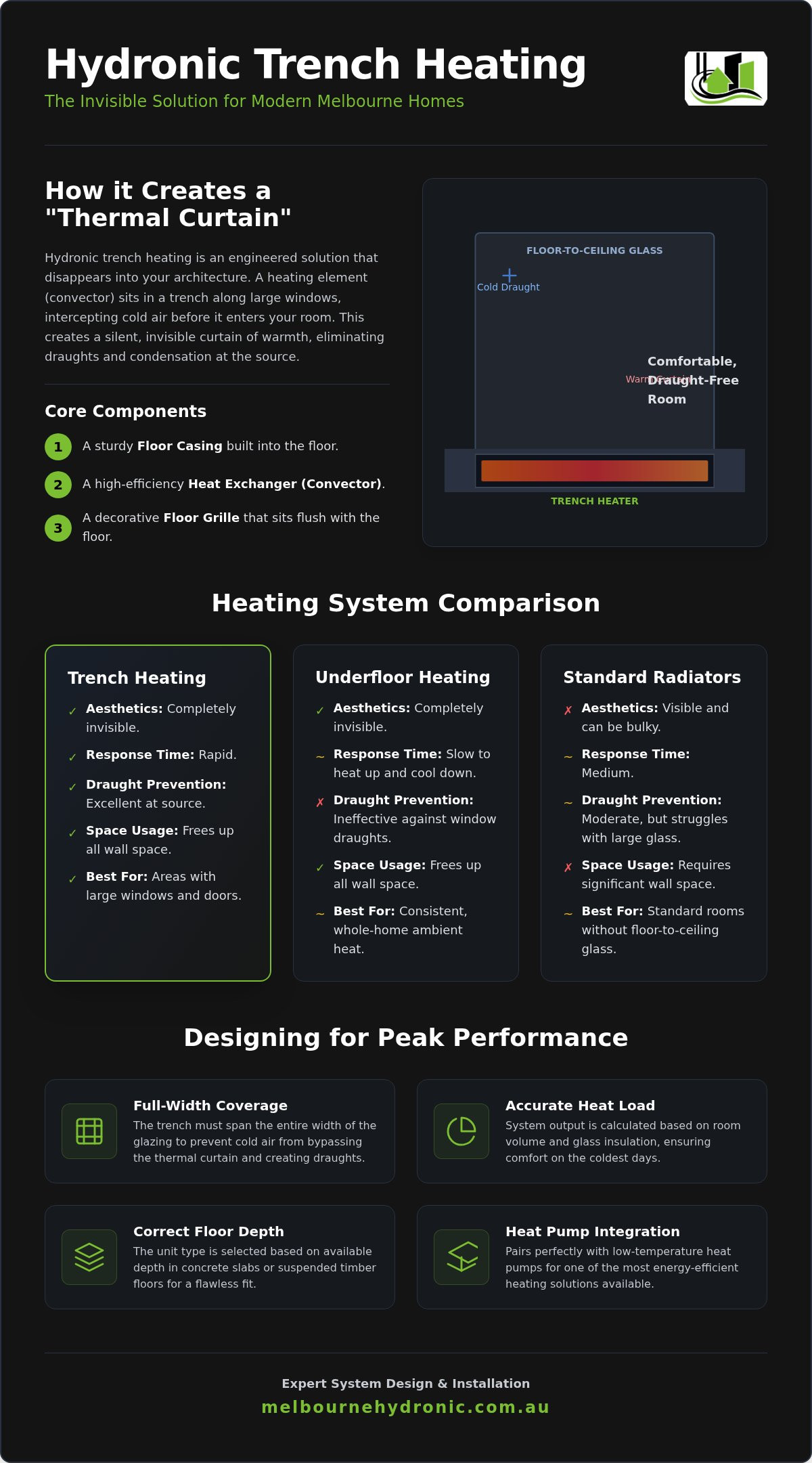
At its core, hydronic trench heating is a clever engineering solution designed to disappear into your architecture. It consists of a heating element, known as a convector, housed within a custom-built trench in your floor. This trench runs along the perimeter of a room, typically positioned directly beneath large windows or sliding doors. For modern Melbourne homes where expansive glass spans are a signature feature, this system provides a level of comfort that traditional wall-mounted units simply cannot match. The system is comprised of three main parts: a sturdy floor casing, a high-efficiency heat exchanger, and a decorative grille that sits flush with your finished floor.
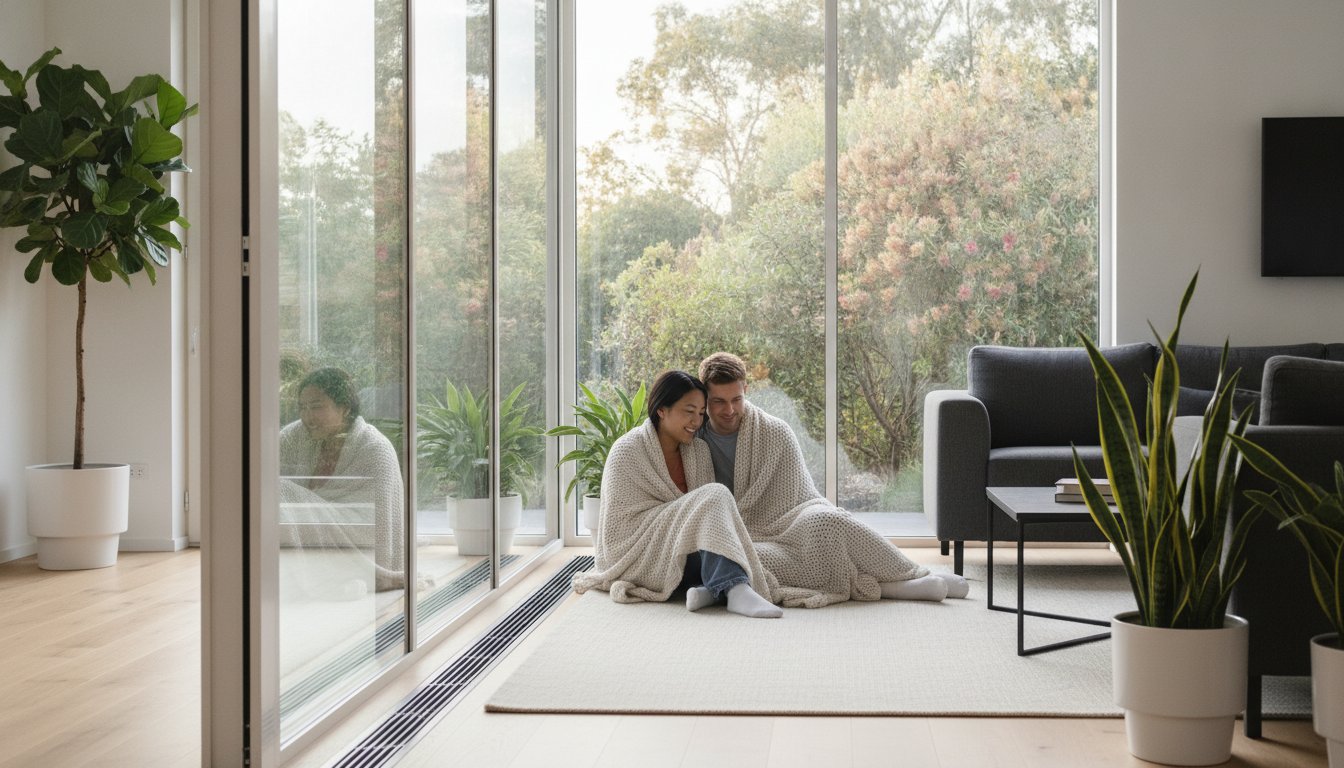
The “Thermal Curtain” is the primary reason architects choose this technology. In Victoria’s colder months, large glass panels act as a cold bridge. This is where the external temperature transfers through the glass, causing heavy, cold air to descend into your living space. Trench heating intercepts this falling air. As the cold air enters the trench, it’s warmed by the convector and rises; this creates a literal curtain of warmth that shields the rest of the room. It’s a proactive approach to heating that stops the chill before it ever reaches your sofa.
The Science of Natural vs. Forced Convection
This process relies on fundamental convection heating principles. In a natural convection system, the air moves on its own as it heats and cools. It’s completely silent and perfect for bedrooms or quiet study areas. For larger open-plan spaces with higher ceilings, we often integrate fan-assisted units. These use small, low-voltage fans to increase the airflow across the heat exchanger. It provides a faster response time and higher heat output without compromising the peaceful atmosphere of your home. You get the performance you need without the noise of a traditional heater.
Trench Heating vs. Standard Hydronic Radiators
While hydronic radiator panels are excellent for many rooms, they aren’t always ideal for premium renovations. Standard radiators require wall space. This often forces you to choose between a warm room and your preferred furniture layout or art collection. Hydronic trench heating reclaims that space. The only visible element is a decorative floor grille, which can be matched to your timber or tile flooring. Beyond aesthetics, radiators placed on internal walls struggle to combat the specific draughts created by floor-to-ceiling glass. Trench heating stops the cold at the source, ensuring your feet stay warm even when the Melbourne weather turns sour.
Designing for Performance: Depth, Placement, and Output
A successful installation of hydronic trench heating isn’t just about the hardware; it’s about the precision of the design. One of the most critical factors we consider is the relationship between the length of your glazing and the length of the trench. To prevent “cold spots” at the edges of a room, the trench should ideally span the entire width of the window. If the unit is too short, cold air will bypass the thermal curtain, causing uncomfortable draughts. Our goal is to create a seamless wall of warmth that protects your living space from the moment the temperature drops outside.
Floor depth is another vital consideration for Melbourne builds. Whether you’re working with a new concrete slab or a renovation of a suspended timber floor, the available depth dictates the type of casing we can install. In modern screed-based floors, we typically have more flexibility. However, for suspended floors, we must carefully navigate joist placements to ensure the system sits perfectly flush. This technical foresight prevents costly onsite modifications and ensures that your heating solution integrates flawlessly with your architectural plans.
Calculating the correct heat load is essential for long-term comfort. We don’t just look at the window size; we calculate the total volume of the room and the insulation properties of the glass. This ensures the system is sized to provide enough warmth even on Melbourne’s frostiest mornings. For those looking for the ultimate in sustainable comfort, we often recommend integration with heat pump hydronic heating. These low-temperature systems are incredibly efficient, and when paired with correctly sized trench convectors, they offer one of the most effective heating solutions for glazed areas available today.
Choosing the Right Grille for Your Interior
The grille is the only part of the system you’ll see, so it must complement your interior design. You can choose from natural timber options like oak or beech, which provide a soft, traditional feel. Alternatively, aluminium grilles offer a sleek, modern look and come in various anodised or powder-coated finishes. We often suggest roll-up grilles for their practicality; they make it easy to access the trench for seasonal cleaning. Whether you’re installing engineered oak or polished concrete, there’s a grille finish that will make your heating system practically invisible.
Placement Strategies for Sliding Doors
For maximum efficacy, the trench must be placed directly against the glass. Even a small gap can allow cold air to spill into the room before it’s intercepted. This requires careful coordination with your door tracks, especially with popular bi-fold or stacking door systems. We also ensure that every grille is load-bearing. In high-traffic entryways, the system must handle the weight of daily life without sagging or making noise. If you’re in the early stages of planning your build, our experts can help you design a high-performance system tailored to your home’s unique layout.
Trench Heating vs. Underfloor Heating: Which is Best?
Choosing between different hydronic delivery systems often comes down to your lifestyle and the specific architecture of your home. While underfloor heating is a beloved choice for many, it operates with a significant thermal lag. Because it relies on heating a concrete slab, it can take several hours to reach your desired temperature. In contrast, hydronic trench heating offers a much faster response time. The copper and aluminium heat exchangers inside the trench warm the air directly. This means you feel the comfort within minutes, making it ideal for Melbourne’s unpredictable weather shifts where you might need heat suddenly on a grey afternoon.
Installation complexity is another deciding factor for Victorian homeowners. Retrofitting full in-slab heating into an existing home is often cost-prohibitive or physically impossible because it requires raising the entire floor level. Trench heating is far more adaptable. We can often integrate it into existing floor structures by creating a targeted perimeter channel. This flexibility allows for precise zoning. You can boost the warmth in a glass-walled living area without needing to heat the entire house, providing an energy-efficient way to manage your home’s comfort without wasting power on unoccupied rooms.
Some of our most successful projects use a hybrid strategy. We might install underfloor coils in the main living areas for consistent background warmth and add trench units specifically along the glass perimeter. This combination provides the best of both worlds: the luxurious feel of warm tiles underfoot and a “thermal curtain” that stops window draughts in their tracks. It’s a sophisticated approach to climate control that addresses the specific weaknesses of modern, glass-heavy architecture.
When to Choose Trench Heating
This system is the superior choice for high-end renovations where you want to keep your original floor levels intact. It’s particularly effective in rooms with floor-to-ceiling sliding doors, where the heat loss through the glass is too great for standard floor coils to manage alone. If you’re looking for an “instant” hydronic solution that doesn’t require a long lead time to feel the warmth, trench heating is your best option.
When Underfloor Heating Wins
Underfloor systems excel in new builds where the concrete slab can be designed as a thermal battery to store heat. It’s the gold standard for large open-plan spaces with stone or tiled floors, providing a gentle, radiant heat that is perfect for families with young children playing on the floor. Because the system is entirely encased in the floor, it’s also virtually maintenance-free regarding dust, making it a simple, long-term solution for many Melbourne families.
Maintenance and Longevity: Keeping Your Trench Clean
One of the most persistent myths about floor-level heating is that the trenches become unhygienic dust traps. This misconception often deters homeowners from choosing a system that is actually remarkably easy to maintain. Modern hydronic trench heating systems are engineered with hygiene in mind; they feature smooth internal casings and grilles that are designed for quick removal. Unlike ducted systems that hide dust deep within inaccessible ceiling pipes, a trench system keeps everything within reach. This transparency ensures that you can maintain a high standard of air quality throughout your home without needing specialised equipment.
Cleaning the internal components doesn’t require a technical background. By simply lifting the decorative grille, you gain full access to the trench casing and the heat exchanger. We recommend using a standard vacuum with a soft brush attachment to remove any accumulated dust from the convector fins. It’s important to be gentle; these aluminium fins are designed for maximum surface area and heat transfer, so bending them can slightly reduce the system’s efficiency. Regular attention here ensures that airflow remains unobstructed and the “thermal curtain” operates at its peak performance throughout the Victorian winter.
Seasonal Cleaning Checklist
To keep your system in top condition, we suggest following a simple routine twice a year. This prevents any debris from affecting the heat output when you need it most.
- Remove and Inspect: Lift the grilles before the first cold snap in autumn. Check for any small objects or pet hair that may have fallen through the slats.
- Vacuum the Casing: Use a narrow nozzle to reach the corners of the trench. This ensures the base remains clean and free of allergens.
- Wipe Down Grilles: Use a damp cloth to clean the timber or aluminium slats. This maintains the premium aesthetic of your flooring and prevents dust from being drawn back into the convection cycle.
- Check for Even Heat: Once the system is running, feel along the length of the trench to ensure there are no cold spots, which could indicate an airlock in the pipes.
Technical Servicing for the Hydronic Loop
While basic cleaning is a DIY task, the longevity of your system depends on professional technical care. An annual hydronic heating service is essential to check the integrity of the entire loop. Our technicians look for signs of corrosion and ensure that the system pressure is balanced. Over time, magnetite or sludge can build up in any hydronic system, which is why power flushing is a critical maintenance step. This process deep-cleans the internal pipework and the trench convector, restoring the flow and ensuring your heat pump or boiler isn’t working harder than it needs to.
A well-maintained trench system can easily last 25 years or more. By keeping the airways clear and the water chemistry balanced, you protect your investment and ensure your home remains a sanctuary of warmth. If you haven’t had your system inspected recently, it is time to book your annual system check with a local expert.
Expert Trench Heating Installation in Melbourne
Installing hydronic trench heating is a precise engineering task that requires more than just standard plumbing skills. It demands a deep understanding of thermal dynamics and architectural integration. At Melbourne Hydronic Heating, we bring a 30-year legacy of Victorian home comfort to every project. We’ve seen how poorly designed systems lead to cold spots and inefficient energy use. Our approach ensures that every convector is positioned with mathematical accuracy, creating a consistent environment that protects your family’s wellbeing and your home’s structural integrity.
The transition toward electrification in Victoria is a major focus for our design team. Under the Gas Substitution Roadmap, new regulations starting in March 2027 will require electric alternatives for end-of-life gas systems. We are already helping homeowners stay ahead of these changes by integrating trench systems with high-efficiency electric heat pumps. For those with existing infrastructure, we also provide expert matching with modern, AGA-certified gas boilers. Our process begins with a detailed architectural consultation and ends only after final commissioning, where we verify that every zone is performing at its peak efficiency.
Service Areas: Melbourne, Geelong, and Beyond
We take pride in being a local, family-owned business that understands the specific climatic challenges of South-Central Victoria. From the salt-air environments of Bayside homes to the exposed, windy sites of regional builds, we tailor our designs to the local landscape. We don’t outsource our work to third-party contractors. Every installation is handled by our dedicated in-house team, ensuring that the technical precision we promise is the technical precision you receive. This internal control allows us to navigate complex local council requirements and energy-efficiency standards with total confidence.
Get a Custom Trench Heating Quote
Preparing for a technical assessment is the first step toward a more comfortable home. If you’re building a new home, having your floor plans ready allows us to calculate the exact heat load and trench dimensions required for each room. For renovation projects, we often recommend a site visit to inspect your existing floor structure and depth. This ensures that the system we propose is physically viable and aesthetically perfect. When you’re ready to invest in an invisible, high-performance heating solution, contact Melbourne Hydronic Heating for a tailored design proposal that reflects the unique needs of your Victorian home.
Secure the Future of Your Home’s Comfort
Choosing the right heating solution for a modern Victorian home often feels like a compromise between aesthetics and performance. As we’ve discussed, hydronic trench heating removes that trade-off entirely. By creating a powerful thermal curtain against large glass spans, this system eliminates draughts and condensation while remaining completely invisible. Whether you’re planning a high-end renovation or a sustainable new build, integrating this technology ensures your living spaces remain warm, healthy, and unobstructed.
With 30+ years of experience in Melbourne and Geelong, our family-owned team specializes in these complex architectural installations. We understand the technical precision required to match trench systems with modern heat pumps or boilers for maximum efficiency. Don’t let your home’s best architectural features become its coldest spots. Our experts are ready to help you design a system that prioritizes your wellbeing and adds long-term value to your property.
Get a Professional Trench Heating Quote for Your Melbourne Home today and experience the difference that local expertise makes. We look forward to helping you create a sanctuary of warmth that you can enjoy for decades to come.
Frequently Asked Questions
Is hydronic trench heating noisy?
Natural convection systems are completely silent because they have no moving parts or fans. If your room requires a fan-assisted model for higher heat output, the low-voltage fans operate at a decibel level that is barely audible. They’re much quieter than standard split systems or traditional ducted heating. This makes them a perfect choice for bedrooms or quiet study areas where you want consistent warmth without any mechanical background hum.
How deep does the floor trench need to be?
Trench depth depends on the specific convector model and your home’s floor structure. Most units require a depth between 90mm and 190mm. In new Melbourne builds with a concrete slab, we coordinate with your builder to leave a precise recess. For renovations with suspended timber floors, we carefully assess the joist depth to ensure the unit sits flush without compromising the integrity of your home’s foundation.
Can I install trench heating in an existing home?
Yes, you can install these systems in existing homes, and it’s often easier than retrofitting underfloor coils. While it requires cutting a channel into your floor, it doesn’t necessitate raising the entire floor level. This makes it a highly effective solution for Victorian renovations where you want to add premium comfort to a living area with large glass doors without a massive or costly structural overhaul.
Are the grilles strong enough to walk on?
Modern floor grilles are fully load-bearing and designed for high-traffic domestic environments. Whether you choose timber or aluminium, the grilles are engineered to support the weight of adults and furniture without bending or rattling. We ensure the frame is installed with technical precision so the grille sits perfectly flush with your flooring; this prevents any tripping hazards while maintaining a sleek, integrated look for your interior.
Does trench heating prevent window condensation?
Preventing window condensation is one of the primary benefits of this system. By placing the heating element directly beneath the glass, it creates a rising curtain of warm air. This warm air increases the surface temperature of the glass, which stops moisture in the room’s air from turning into liquid. It keeps your views clear and protects your window frames from moisture-related damage or unsightly mould growth.
How often do I need to clean the trench?
We recommend a quick seasonal clean twice a year to maintain peak performance. Before the winter surge, you should lift the grilles and use a vacuum with a soft brush attachment to remove any dust from the convector fins. This simple habit ensures that the airflow remains unobstructed. It also keeps your indoor air quality high, which is a significant health benefit for families with allergies or respiratory sensitivities.
Can trench heating be used with a heat pump?
Hydronic trench heating is perfectly compatible with modern electric heat pumps. Because heat pumps operate most efficiently at lower water temperatures, we size the trench convectors to match this specific output. This combination is an excellent way to future-proof your Melbourne home as the state moves toward electrification. It provides a sustainable, high-performance heating solution that works in harmony with Victoria’s evolving energy regulations and construction standards.
Is trench heating more expensive than radiators?
Trench systems generally involve a higher initial investment than wall-mounted radiator panels. This is because the installation requires specialized floor trenching and custom-fitted decorative grilles. However, many homeowners find the extra cost is justified by the invisible finish and the superior performance near large glass spans. It’s an architectural choice that adds significant value to premium properties while reclaiming valuable wall space for your furniture or art collection.