
Hydronic Underfloor Heating Cost Melbourne: 2026 Price & Planning Guide
What if the most important decision you make for your Melbourne home this year isn’t about the floor’s appearance, but the technology hidden beneath it? With the 2026 shift in Victorian energy policies and the upcoming March 2027 gas replacement mandates, many homeowners feel overwhelmed by technical jargon and fluctuating utility rates. You’re likely wondering about the actual hydronic underfloor heating cost melbourne residents should expect when balancing immediate comfort with long-term affordability. It’s completely normal to feel anxious about hidden installation fees or whether a screed system is truly worth the extra investment over an in-slab setup.
We’re here to clear the air and provide the professional guidance you need to make an informed choice for your family’s well-being. This guide breaks down the essential factors that drive your quote, from the efficiency of modern electric heat pumps to the specific benefits for asthma sufferers. You’ll discover how to leverage current Victorian Energy Upgrades (VEU) rebates and Solar Victoria incentives to offset your initial outlay. We will provide a clear roadmap for achieving a dust-free, energy-efficient home that delivers lower bills and a premium living experience for decades to come.
Key Takeaways
- Understand how total floor area and Victoria’s 7-star energy standards directly influence your initial system capacity and overall project quote.
- Compare the technical differences between in-slab and in-screed installations to identify the most efficient solution for your specific build or renovation.
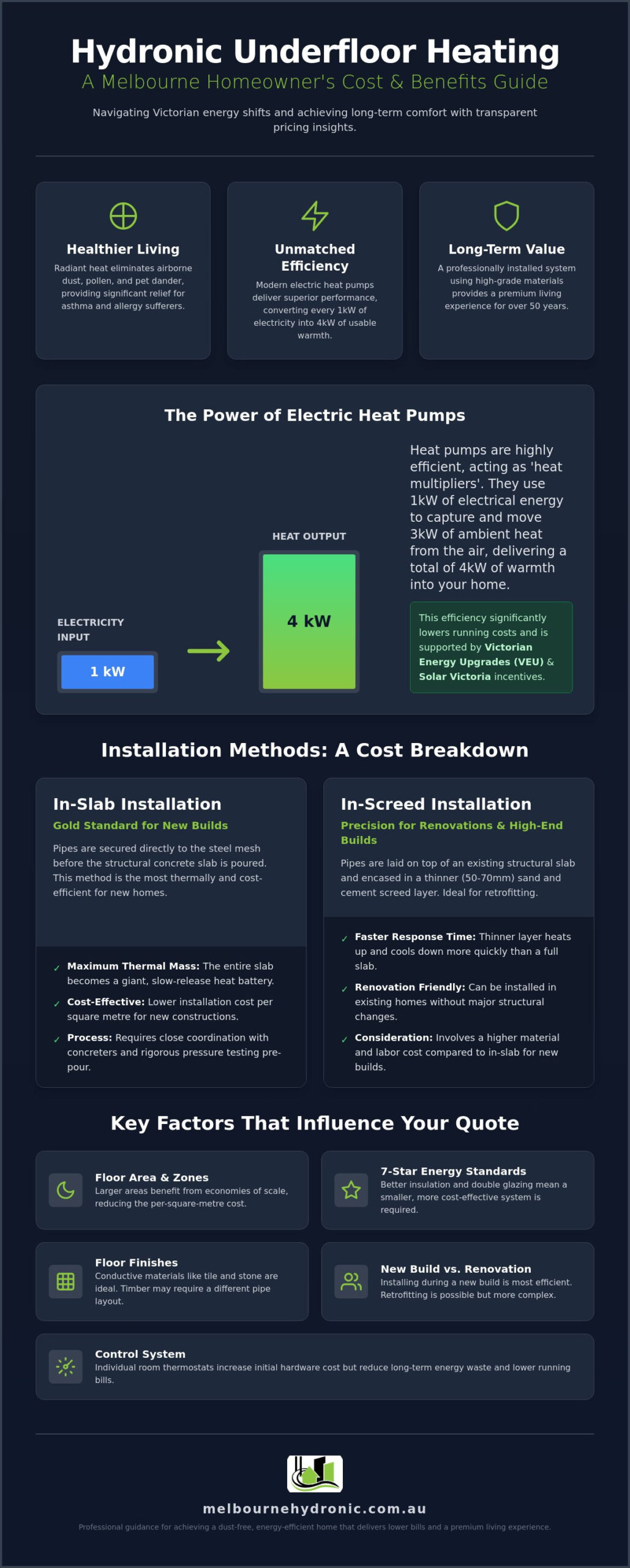
- Learn how electric heat pumps lower the ongoing hydronic underfloor heating cost melbourne homeowners face by converting 1kW of power into 4kW of usable warmth.
- Identify the long-term health benefits of dust-free heating and the essential maintenance steps required to protect your system from internal corrosion.
- Discover the documentation and site-specific details required to secure a precise, transparent quote for your Melbourne or Geelong project.
Factors Influencing Hydronic Underfloor Heating Costs in Melbourne
Calculating the hydronic underfloor heating cost melbourne families face involves more than just measuring a room. Economies of scale play a huge role; larger zones often provide better per-square-metre value because the fixed costs of the heat source and manifold are spread across a bigger area. It’s about finding the “sweet spot” in your floor plan where the system’s efficiency matches your lifestyle needs. When we design a system, we don’t just look at the floor; we look at the entire thermal envelope of the building.
Victoria’s recent shift toward 7-star energy ratings for new homes has a direct impact on your quote. High-quality insulation and double glazing keep heat trapped inside, meaning your system doesn’t need to work as hard. This often allows for a smaller, more cost-effective electric heat pump or boiler to achieve the same level of comfort. Precision control also matters. While adding individual room thermostats increases the initial hardware cost, it allows you to only heat the rooms you’re using, preventing energy waste and lowering long-term bills.
Beyond the financial investment, there’s a significant health value that many competitors overlook. Underfloor heating systems operate through radiant heat rather than forced air. For Melbourne families dealing with asthma or seasonal allergies, this means no dust, pet dander, or pollen is being blown around the home. It’s a premium lifestyle choice that prioritizes well-being and hygiene alongside warmth. When you factor in the hydronic underfloor heating cost melbourne residents pay, this “health-first” benefit provides a value add that lasts for decades.
Home Design and Thermal Mass
Concrete slabs act as a giant thermal battery. They absorb heat during the day and release it slowly at night, which is incredibly efficient for Melbourne’s cold winters. Your choice of floor finish matters too. High-quality tiles and natural stone surfaces, such as those from Plusco Ceramics, conduct heat beautifully, while engineered timber acts as a slight insulator and may require a different pipe layout. Even ceiling height plays a part; since hydronic heat stays low where you need it, you won’t waste money heating the empty space near a high ceiling.
New Build vs. Renovation Logistics
The most cost-efficient time to install is during the slab-pour phase of a new build. Retrofitting into existing Melbourne weatherboards is possible but requires more complex routing for pipework and manifold access. If you’re renovating, we often integrate the system into a new screed layer. This avoids major structural changes and ensures the installation remains as non-invasive as possible while still delivering that signature underfloor comfort.
In-Slab vs. In-Screed: Installation Cost Breakdown
The method used to house your pipework is the single biggest variable in the hydronic underfloor heating cost melbourne residents encounter during a build or renovation. In-slab heating is the gold standard for new Melbourne homes, where pipes are secured directly to the structural steel mesh before the concrete is poured. In contrast, in-screed systems are installed on top of an existing floor and encased in a thinner layer of sand and cement. While in-slab is generally more economical for large, open-plan new builds, in-screed offers the technical precision needed for high-end renovations where floor heights are restricted.
Labor intensity varies significantly between these two approaches. Mesh-tied systems require technicians to manually secure every centimetre of pipe to the reinforcement, a process that demands physical stamina and technical accuracy. Newer clip-track or studded mat systems can speed up the installation phase but involve different material costs. Regardless of the installation style, the quality of the pipe itself is where you shouldn’t compromise. High-grade PEX-a piping, known for its superior cross-linked molecular structure, provides the best resistance to temperature fluctuations and pressure. It’s a non-negotiable choice for any system intended to function reliably for fifty years or more.
The In-Slab Pour Process
Coordination is the most critical factor here. We work closely with your concreters to ensure the pipework layout respects all structural load requirements. Before a single drop of concrete is poured, we perform rigorous pressure testing protocols. This ensures the system is 100% airtight, giving you total confidence that no leaks will occur once the slab is set. We also prioritize high-density thermal insulation layers beneath the slab to prevent heat loss into the soil, an essential step highlighted in this Australian Government guide to heating.
Screed Systems for Renovations
For those updating a classic Melbourne weatherboard or a multi-story townhouse, screed systems provide a path to modern comfort without structural upheaval. These systems allow us to add hydronic warmth to existing ground floors with minimal height increase. On upper stories, we carefully evaluate weight considerations for timber floor installations to ensure the building’s integrity. It’s important to account for drying times in your project schedule; standard screeds often require several weeks to cure before you can lay your final floor finishes. If you’re weighing up these options for your own home, exploring our design options can help you decide which method fits your timeline and budget.
Running Costs: Electric Heat Pumps vs. Gas Boilers in 2026
The 2026 energy landscape in Victoria marks a definitive turning point for residential heating. With the Victorian Default Offer (VDO) for electricity decreasing by 5% while gas tariffs continue to rise by a similar margin, the math behind your home’s climate control has changed. When evaluating the hydronic underfloor heating cost melbourne families must consider, the focus has shifted from the initial purchase price to the total cost of ownership. Choosing the right heat source today determines whether you’ll be insulated from future price hikes or tethered to an increasingly expensive gas network.
Air-to-water heat pumps have become the preferred choice for modern Melbourne homes due to their incredible efficiency. This is measured by the Coefficient of Performance (COP). While a high-efficiency gas boiler might reach 95% efficiency, a modern heat pump operates at 300% to 400%. This means for every 1kW of electricity the system consumes, it delivers 3 to 4kW of heat into your floors. By extracting “free” thermal energy from the ambient air, these systems provide a level of performance that gas simply cannot match. It’s a sophisticated way to keep your home at a perfect 21 degrees without the heavy environmental or financial toll of traditional combustion.
Solar integration takes these savings even further. Melbourne’s sunny winter days provide the perfect opportunity to run your underfloor system using rooftop PV generation. Since concrete slabs act as thermal batteries, you can “charge” your floors with heat during the middle of the day when solar production is at its peak. This stored energy then radiates slowly throughout the evening, effectively allowing you to heat your home for free. This synergy between solar power and hydronic technology is a major factor in why the hydronic underfloor heating cost melbourne residents pay is often recouped much faster than expected.
The Shift to Electric Hydronic Heating
Moving to an all-electric setup is about more than just immediate savings; it’s about future-proofing. With the March 1, 2027, deadline for replacing end-of-life gas hot water systems with electric alternatives approaching, many homeowners are making the switch now. Upgrading to electric heat pumps can reduce your heating-related energy costs by 60% to 70% compared to gas. It also eliminates the need for a gas connection fee, further simplifying your utility bills.
Maintenance and Efficiency Gains
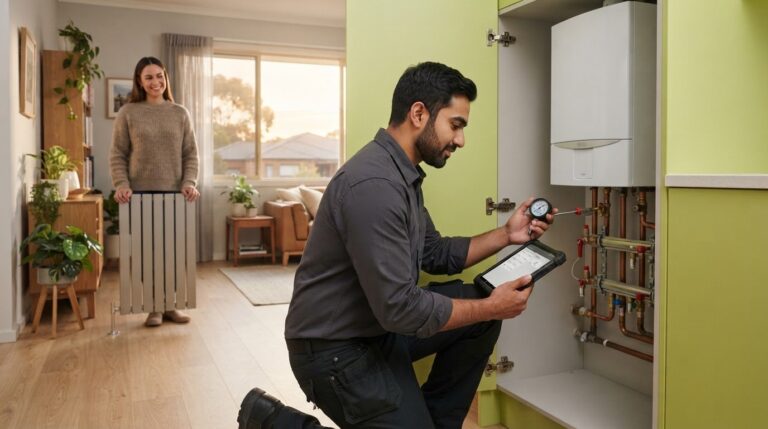
Keeping your system at peak performance requires a proactive approach. Regular servicing ensures that actuators, pumps, and sensors are calibrated correctly, preventing minor issues from becoming costly repairs. Over time, internal corrosion can create sludge that restricts flow. We recommend power flushing every five years to maintain the system’s hygiene and efficiency. When combined with smart thermostats and weather compensation sensors, these maintenance steps ensure your system only uses the exact amount of energy required to maintain your comfort.
Hidden Costs and Long-Term Maintenance for Melbourne Systems
While the initial hydronic underfloor heating cost melbourne residents plan for covers the hardware and labor, the system’s longevity depends on what happens after the installers leave. It’s not just about the pipes in the ground; it’s about the chemistry and mechanical health of the entire network. Water treatment is often overlooked but remains critical for preventing internal corrosion. We use specialized inhibitors to treat the water within the underfloor loops, ensuring that oxygen doesn’t react with metal components. Without this, you risk pinhole leaks or blockages that can be difficult and expensive to rectify once the floor is finished.
The manifold acts as the heart of your installation, housing the actuators and balancing valves that regulate heat for every room. These moving parts require periodic checks to ensure they haven’t stuck or lost calibration. Most high-quality circulation pumps have a lifecycle of 15 to 20 years, but their efficiency drops if they’re forced to work against a fouled system. Neglecting these small maintenance steps has a direct impact on the overall hydronic underfloor heating cost melbourne homeowners face over time, as energy consumption rises to compensate for poor flow. Booking a regular hydronic heating service is the most effective way to protect your investment and keep your system running at its 2026 efficiency benchmarks.
System Balancing and Commissioning
Initial setup is everything for a radiant system. A system that isn’t balanced correctly will result in uneven heat, where some rooms feel like a sauna while others remain chilly. This imbalance forces your heat pump to run longer than necessary, driving up utility bills. Professional commissioning involves measuring and setting flow rates for every individual loop according to the specific heat loss of that room. While some standard plumbing installs might treat this as an afterthought, re-balancing a poorly set up system later is often more costly than doing it right during the initial handover.
Sludge Prevention and Power Flushing
If you notice that certain areas of your floor take significantly longer to warm up than they used to, it’s a sign of poor circulation. This is usually caused by magnetite or “sludge” building up inside the pipework. This debris restricts water flow and creates a barrier that prevents heat from transferring effectively to your floor surface. Power flushing serves as a vital preventative measure that clears internal debris to maximize system longevity and reduce strain on your circulation pumps. By restoring the original thermal efficiency of your floors, you ensure your system continues to deliver that premium comfort without an increase in power usage.
Ready to ensure your system is running at peak efficiency? Schedule your system health check with our specialist team today.
Getting an Accurate Quote for Your Melbourne Hydronic Project
Securing a precise figure for your home’s climate control starts with transparency and detail. To determine the true hydronic underfloor heating cost melbourne homeowners should expect, we move beyond generic square-metre estimates. Every home has a unique thermal profile. We begin by analyzing your architectural floor plans to perform a heat loss calculation. This process accounts for room volumes, window orientations, and the specific “R-values” of your insulation. Providing these documents upfront ensures your quote reflects the exact capacity required to keep your family comfortable during a cold Port Phillip Bay winter.
While floor plans work for new builds, a site visit is essential for renovations across Melbourne and Geelong. We need to inspect the structural integrity of your subfloor and identify the best routing for pipework and manifold placement. These technical details often dictate the difference between a standard install and a complex retrofit. With over 30 years of local experience, we’ve seen how minor site variables can impact long-term performance. We prioritize these early inspections to eliminate the “hidden surprises” that often plague less experienced contractors.
When you compare quotes, look beyond the final number. A cheaper quote might utilize lower-grade piping or generic manifolds that lack the precision balancing valves required for even heat distribution. Investing in high-quality components and a design backed by decades of expertise ensures your system remains an asset rather than a maintenance burden. We focus on delivering a system that operates silently and efficiently, providing that signature radiant warmth that transforms your living environment into a sanctuary of well-being.
What to Include in Your Quote Request
To help us tailor a solution for your lifestyle, specify whether you prefer a high-efficiency electric heat pump or a traditional gas boiler. Include details about your intended floor finishes, as the thermal resistance of thick carpet differs significantly from polished concrete or tiles. If you’re still early in the planning phase, you can read our complete underfloor guide to better understand how these choices affect your project’s scope.
Choosing a Specialist Installer
Hydronic technology is a specialized field that sits at the intersection of mechanical engineering and traditional plumbing. General plumbers often lack the diagnostic tools and specific training required to commission complex underfloor circuits correctly. Always verify that your installer is a licensed Victorian practitioner with a proven track record in radiant systems. This expertise is what guarantees your system will qualify for the latest VEU rebates and operate at its peak COP for years to come. Ready to take the next step? You can request a custom quote from Melbourne Hydronic Heating to start your journey toward a healthier, more comfortable home.
Secure Your Home’s Future Comfort Today
Choosing the right heating system is an investment in your family’s well-being and long-term financial independence. As Victoria moves toward an all-electric future, the hydronic underfloor heating cost melbourne families plan for today will be offset by years of superior efficiency and significantly lower energy bills. Whether you’re coordinating a structural pour for a new build or integrating a slimline screed system into a renovation, the key is professional design and high-quality components. We’ve seen how the right heat pump technology, paired with expert installation, transforms a house into a sanctuary for asthma and allergy sufferers.
Since 1990, our family-owned business has provided Melbourne and Geelong residents with technical precision and honest advice. With 30+ years of local expertise, we specialize in energy-efficient heat pump technology to ensure your home meets the highest standards of comfort and sustainability. Get an expert hydronic underfloor heating quote for your Melbourne home to start your journey toward a cleaner, warmer living space. You deserve a home that works for you, providing silent, invisible, and perfectly balanced warmth for decades to come.
Frequently Asked Questions
How much more does hydronic underfloor heating cost than radiators?
Underfloor systems generally require a higher initial investment than radiator panels because of the extensive labor and materials needed for slab or screed integration. While radiators are a fantastic choice for retrofitting existing homes with minimal disruption, underfloor heating provides a completely invisible finish and a more uniform heat distribution. The final price difference depends on your floor area and whether you’re coordinating the install with a new concrete pour or a renovation.
Can I install hydronic underfloor heating under carpet or timber floors?
Yes, you can install these systems under most floor finishes, including carpet and engineered timber, provided the materials meet specific thermal resistance standards. While tiles and polished concrete offer the best heat conduction, specialized underlays and careful system calibration allow timber and carpet to perform beautifully. It’s essential to share your flooring choices with us during the design phase so we can adjust pipe spacing and water temperatures accordingly.
Is there a rebate for installing a hydronic heat pump in Melbourne in 2026?
Eligible Melbourne households can access a Solar Victoria rebate of up to $1,000 for high-efficiency heat pumps or up to $1,400 for Australian-made products as of July 2026. It’s important to note that the household taxable income cap for this program was lowered to $150,000 per year on July 1, 2026. You may also benefit from point-of-sale discounts through the Victorian Energy Upgrades (VEU) program, which reduces the upfront cost by generating energy efficiency certificates.
How long does it take for underfloor heating to warm up a room?
Warm-up times depend on your installation method; in-slab systems typically take 4 to 8 hours to reach the target temperature, while in-screed systems react much faster, often within 1 to 2 hours. Because concrete slabs act as thermal batteries, they continue to radiate warmth long after the heat source has switched off. This makes them ideal for maintaining a stable, comfortable “background” temperature throughout the fluctuating Melbourne winter weather.
What is the most energy-efficient way to run hydronic floor heating?
The most efficient strategy is to maintain a consistent thermostat setting rather than turning the system on and off frequently. To achieve the best hydronic underfloor heating cost melbourne residents can find, we recommend pairing an electric heat pump with a rooftop solar PV system. By running your heating during the day, you can “charge” your concrete slab with free solar energy, which then keeps your home warm all night without drawing from the grid.
Does hydronic underfloor heating require a special boiler or heat pump?
Most modern underfloor systems perform best when paired with a low-temperature heat source like an air-to-water heat pump or a condensing gas boiler. Heat pumps are particularly effective because they’re designed to operate at the lower water temperatures (35 to 45 degrees Celsius) required for floor loops. This allows the system to reach a much higher Coefficient of Performance (COP) than traditional high-temperature systems, significantly reducing your monthly energy consumption.
How often should a Melbourne hydronic system be serviced?
We recommend a professional system health check every 12 months to ensure all mechanical components and water chemistry remain in peak condition. A standard annual service for a Melbourne system typically costs between $250 and $400, covering essential checks on manifold actuators, pumps, and pressure levels. Regular maintenance is the best way to prevent the buildup of internal sludge and ensures your system continues to operate at its original 2026 efficiency ratings.
Can underfloor heating be used for cooling in Melbourne summers?
While reversible heat pumps can technically circulate cold water, radiant floor cooling is generally not recommended for Melbourne homes due to the risk of surface condensation. Cooling a floor below the dew point can create slip hazards or damage timber finishes. For a complete year-round solution, we recommend integrating fan coils or trench heating units that are specifically designed to manage both temperature and humidity without causing moisture issues on your floors.