
Signs Your Hydronic Boiler Needs Replacing: The 2026 Melbourne Homeowner’s Guide
A 15-year-old boiler isn’t just a vintage appliance; it’s a growing liability on your Melbourne utility bill. With Victoria’s gas transition policies moving quickly, that minor leak or pilot light flicker is no longer just a weekend repair job; it’s a signal that your home’s comfort and safety are at risk. Recognizing the early signs your hydronic boiler needs replacing is the difference between a planned, rebate-supported upgrade and an expensive, freezing mid-winter emergency.
We understand the anxiety that comes with rising energy prices and the confusion surrounding the upcoming 2027 gas phase-out for system repairs. You want a home that’s consistently warm, quiet, and healthy for your family without the constant fear of carbon monoxide or surprise breakdowns. This 2026 guide promises to simplify your decision by highlighting the critical warning signs of a failing boiler and showing you how to slash your annual bills. We’ll walk you through the latest electric heat pump transitions, explain how to maximize Victorian Energy Upgrades (VEU) rebates, and help you choose a reliable path toward a more sustainable, premium living environment.
Key Takeaways
- Identify the critical performance red flags and the 15-year milestone that signals your hydronic boiler needs replacing before a winter emergency occurs.
- Learn how internal “black sludge” and outdated cast iron technology could be creating a 28% efficiency gap, driving up your Melbourne energy bills.
- Apply the “50% rule” to calculate whether a repair is a wise investment or if a full system upgrade offers better long-term value.
- Discover how transitioning to modern gas condensing units or electric heat pumps can help you access Victorian Energy Upgrades (VEU) rebates.
- Understand the professional replacement process and why Energy Safe Victoria (ESV) compliance is vital for a safe, allergy-friendly home environment.
The 15-Year Milestone: Critical Performance Red Flags
While a well-maintained system provides decades of comfort, the 15 to 20-year mark is widely considered the danger zone for Melbourne homes. At this age, the internal components of your hydronic heating system begin to suffer from cumulative thermal stress and mineral buildup. If you’ve noticed your winter gas bills creeping up despite similar usage patterns, it’s often the first of many signs your hydronic boiler needs replacing. Older units lose their ability to transfer heat efficiently; this forces the burner to run longer and consume more fuel to achieve the same result.
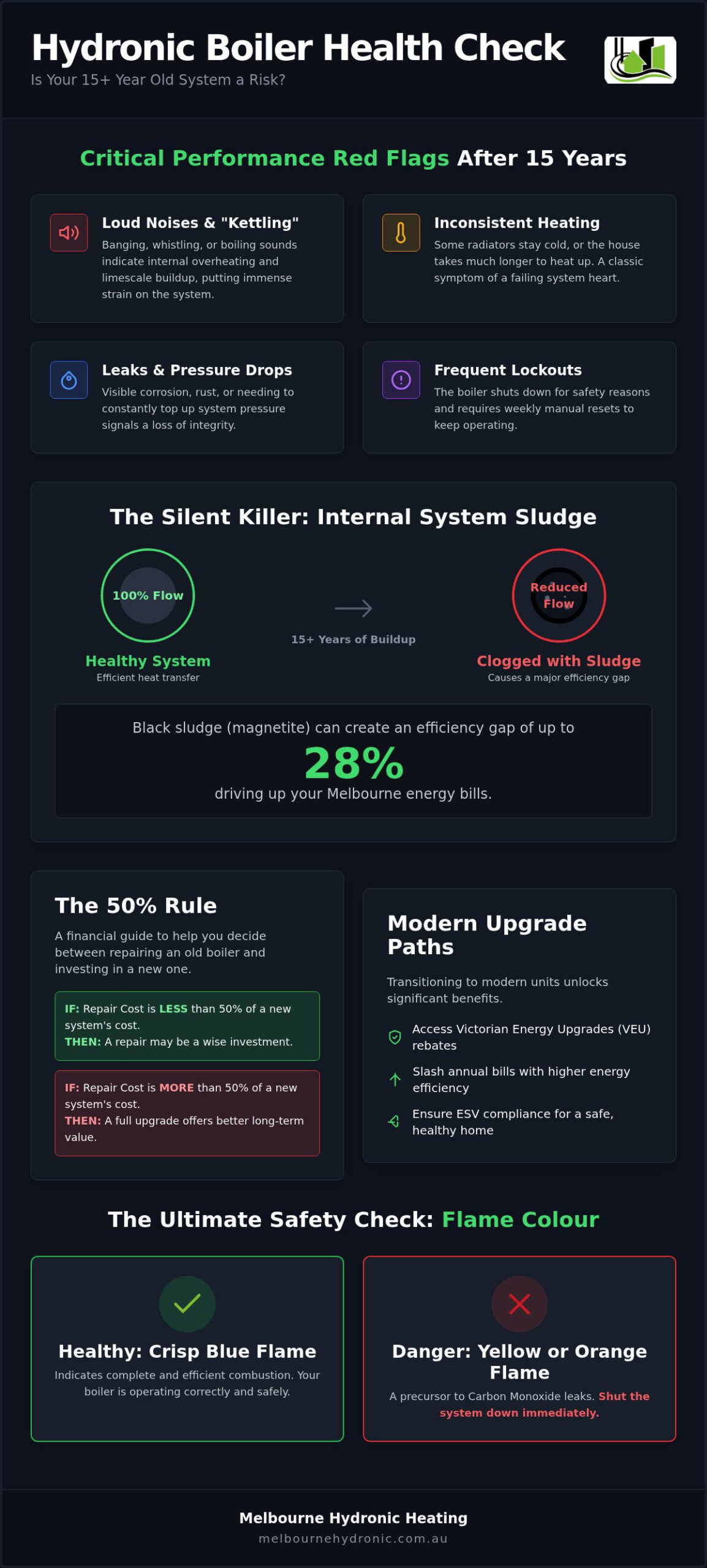
Safety is the most critical imperative for any Victorian homeowner. A healthy gas boiler should always produce a crisp, blue flame. If you see a lazy yellow or orange flame, or notice dark soot marks around the casing, shut the system down immediately. These are precursors to carbon monoxide leaks and suggest the heat exchanger is no longer venting correctly. In these cases, a full replacement is usually the only safe path forward.
Performance Red Flags to Watch For
Inconsistent heat distribution is a classic symptom of a failing heart. You might find that some hydronic heating panels stay lukewarm while others are hot, or the entire house takes hours longer to reach a comfortable temperature than it did in previous years. Watch for these specific performance failures:
- The system takes significantly longer to reach the thermostat set point.
- Frequent “lockouts” where the boiler shuts down for safety.
- The need to manually reset the system weekly to maintain operation.
These recurring glitches are clear signs your hydronic boiler needs replacing before it fails completely during a Melbourne cold snap.
Visual Cues of Internal Failure
Don’t ignore what you can see during a quick inspection. Check the pipework connections and the heat exchanger for visible corrosion or white, chalky mineral deposits. Persistent pressure drops that require you to top up the system every few days suggest a leak that’s slowly eroding the unit’s integrity. It’s vital to remember that external rust often indicates catastrophic internal damage that’s already compromised the boiler’s structural safety and efficiency.
Hidden Deterioration: Efficiency Loss and System Sludge
While external rust and strange noises are obvious warnings, the most damaging signs your hydronic boiler needs replacing often occur deep within the system’s core. Over decades, the constant interaction between water and the internal steel of your radiators creates a substance known as magnetite. This dense, black iron oxide sludge is a silent efficiency killer. It doesn’t just settle at the base of your radiators; it circulates through your entire network, coating the heat exchanger in a layer of thermal insulation that prevents heat from transferring to your home.
This internal buildup forces the entire system to overwork. When the water becomes thickened with debris, the boiler pump must consume more electricity to maintain flow. This leads to premature failure of sensitive components like diverter valves and seals. If you’ve noticed that your system feels sluggish or requires constant adjustments, it might be time to consider a professional power flushing. This diagnostic process can reveal whether your system is merely dirty or if the internal corrosion has reached a point of no return.
The Silent Killer: Magnetite and Corrosion
Magnetite buildup is the primary reason for “cold spots” in your radiator panels. When sludge accumulates at the bottom of a panel, it blocks the flow of hot water, leaving large sections of the radiator cold to the touch. Your boiler then runs for longer cycles to compensate for this lost surface area. Older boilers lack the sophisticated magnetic filtration systems required to trap modern levels of sludge, meaning the abrasive particles continue to grind away at the heat exchanger’s internal walls until a catastrophic leak occurs.
Quantifying Your Efficiency Loss
The financial impact of an aging boiler is measurable. In Melbourne, an old cast iron boiler often operates with a 28% efficiency gap compared to a modern condensing unit. This means for every dollar you spend on gas, nearly 30 cents is wasted through the flue. For an average Melbourne family, this inefficiency can add over A$450 to annual heating costs. Much of this loss is due to thermal shock, which is the physical stress caused by rapid temperature fluctuations that lead to microscopic cracks in the heat exchanger’s metal. Once these cracks form, the unit’s structural integrity is compromised, and replacement becomes the only safe option. If you’re concerned about your system’s performance, a quick boiler health check can provide the clarity you need to plan for a more efficient future.
The Repair vs. Replace Financial Threshold in 2026
Deciding whether to sink more money into a failing system or invest in a new one is a calculation every long-term Melbourne homeowner eventually faces. In 2026, we advise our clients to apply the “50% Rule” as a professional benchmark. If a single repair quote for a major component reaches half the cost of a modern installation, you’re likely throwing good money after bad. When you combine this with the increasing frequency of breakdowns, the financial case for a strategic upgrade becomes undeniable. These recurring repair bills are often the most expensive signs your hydronic boiler needs replacing, as they represent capital that could have been used to offset a high-efficiency unit.
Calculating the Total Cost of Ownership (TCO) over a five-year period reveals the true hidden expense of an old boiler. While a repair might cost less today, the cumulative cost of higher gas consumption, emergency call-out fees, and the inevitable next component failure often exceeds the price of a new system. Many homeowners make the mistake of requesting “like-for-like” swaps, but 2026 standards prioritize smarter transitions. By factoring in the current Victorian Energy Upgrades (VEU) scheme offsets, the initial investment for a modern condensing boiler or electric heat pump is significantly reduced, making the long-term ROI much faster than it was just a few years ago.
The Repair Trap: When to Stop Patching
Major components like heat exchangers, main PCBs, and gas valves are the most common “repair traps.” Replacing a single high-tech part in an aging unit often triggers a “Cascade Failure” effect. The new, high-performance component can place additional mechanical stress on the remaining older parts, such as the pump or seals, leading to a secondary breakdown within months. Beyond the parts themselves, you must consider the warranty. Transitioning from a system with zero coverage to a new unit with a 5 to 10-year manufacturer guarantee provides a level of financial security that a simple repair can’t match.
ROI of a Modern Replacement
A modern upgrade does more than just lower your monthly energy consumption. It fundamentally modernizes your home’s infrastructure. For properties with premium underfloor heating, a new, precisely controlled boiler or heat pump ensures the system operates at its designed peak efficiency, directly increasing property value. There’s also the “Peace of Mind” factor to consider. Eliminating the anxiety of a total system failure in mid-July, when Melbourne’s temperatures drop and emergency technicians are at their busiest, is a benefit that’s difficult to put a price on but essential for your family’s well-being.
Modern Upgrades: Transitioning to Gas Condensing or Electric Heat Pumps
Once the signs your hydronic boiler needs replacing become undeniable, your choice between gas and electricity becomes a strategic long-term investment. In 2026, Melbourne homeowners are navigating a rapidly shifting regulatory environment. With the Victorian government’s mandate for all-electric new builds starting January 1, 2027, and new restrictions on repairing older gas appliances in rental properties by March 2027, your decision today impacts your home’s resale value and operational viability for the next two decades. Choosing a modern system isn’t just about restoring heat; it’s about aligning your home with the future of Victorian energy standards.
The transition requires a technical evaluation of your current infrastructure. While older cast iron boilers operated at very high temperatures, modern alternatives prioritize efficiency through smarter modulation. Before committing to a specific technology, we assess whether your existing pipework and radiator sizing can handle the lower flow temperatures required by high-efficiency systems. This compatibility check ensures your home remains comfortable even on the coldest Geelong or Melbourne nights without overworking your new investment.
The Case for Electric Heat Pumps
Transitioning to Heat Pump Hydronic Heating is the most effective way to future-proof your property against rising gas tariffs. These systems extract ambient heat from the outside air, often achieving a coefficient of performance (COP) between 3.5 and 4.0. This means for every 1 kW of electricity consumed, you receive up to 4 kW of heat. When integrated with a home solar PV system, you can effectively run your heating for free during daylight hours. It’s a clean, zero-emission solution that significantly reduces your household’s carbon footprint while providing the silent, allergy-friendly warmth hydronic systems are famous for.
High-Efficiency Gas Condensing Options
For many established Melbourne homes, high-efficiency gas condensing boilers remain the most practical “drop-in” replacement. These units are engineered to capture latent heat from flue gases that older systems simply vent into the atmosphere, achieving much higher efficiency ratings. Modulating burner technology allows the boiler to adjust its flame and output precisely to meet the home’s current heat demand, significantly reducing fuel waste. While they are the easiest replacement for existing radiator networks, they do require specific modifications, including the installation of a condensate drain and updated flueing to safely handle the cooler exhaust. If you’re ready to explore your options, book a consultation with our expert team to find the perfect fit for your home.
The Replacement Process: Ensuring Your Melbourne Home’s Comfort
Once you’ve identified the undeniable signs your hydronic boiler needs replacing, the focus shifts from diagnosis to the engineering precision of a professional installation. A replacement day with Melbourne Hydronic Heating is a methodical process designed to restore your home’s comfort with minimal disruption. Unlike a standard plumbing job, replacing a hydronic heart requires a deep understanding of system flow rates and pressure dynamics. Our 30-year legacy in Victoria means we don’t just swap one box for another; we recalibrate your entire home’s heating ecosystem to ensure every room receives the exact amount of energy required for a premium living experience.
Safety and legal compliance are the foundations of our work. Every installation we perform adheres to the latest Energy Safe Victoria (ESV) standards. Upon completion, you receive a Victorian VBA Certificate of Compliance, which is essential for your home insurance and provides peace of mind that the system is vented and sealed to the highest technical benchmarks. We also perform a critical “system balancing” phase. This involves adjusting the flow at each radiator or floor circuit to ensure the new boiler doesn’t just run efficiently, but also distributes heat evenly across the entire property without creating noisy air pockets or cold zones.
Technical Site Assessment
Our process begins with a rigorous technical assessment of your existing infrastructure. We evaluate your pipework to ensure it can handle the operating pressures of a modern system, especially if you’re transitioning from an older, open-vented unit. A key part of this assessment is determining the precise kilowatt (kW) rating required for your home’s specific heat load. Over-sizing a boiler leads to inefficient “short-cycling,” while under-sizing leaves you cold in July. During this stage, we also identify opportunities to modernize your comfort, such as integrating high-output hydronic towel rails or trench heating into the updated network.
Post-Installation Support
The relationship doesn’t end when the burner first ignites. We walk you through your new smart thermostat and system controls, ensuring you know how to maximize your energy savings through scheduled zoning. Because modern condensing boilers and heat pumps are precision-engineered, the first 12-month service is vital to maintaining your manufacturer’s warranty and verifying that the system has settled correctly. This proactive approach prevents the very issues that lead to the signs your hydronic boiler needs replacing in the first place. If your system is struggling, book your professional boiler assessment with Melbourne Hydronic Heating today to secure your home’s winter comfort.
Secure Your Home’s Winter Comfort and Energy Efficiency
Modernizing your home’s heating is a strategic investment in both comfort and long-term property value. Recognizing the early signs your hydronic boiler needs replacing protects you from the stress of emergency mid-winter repairs and the ongoing financial drain of inefficient operation. By moving beyond the repair trap and utilizing current VEU rebates, you can upgrade to a system that provides silent, allergy-friendly warmth while significantly slashing your utility costs.
Melbourne Hydronic Heating brings over 30 years of specialist experience to every Victorian home. As a family-owned and operated contractor, we pride ourselves on delivering Energy Safe Victoria (ESV) compliant installations that meet the highest technical standards. We understand the unique climate challenges in Melbourne and Geelong, ensuring your new system is perfectly balanced for your specific floor plan. Don’t wait for a total system failure to compromise your family’s well-being. Take the first step toward a more reliable, sustainable, and premium living environment today.
Request a Professional Boiler Replacement Quote for Your Melbourne Home
Frequently Asked Questions
How long do hydronic boilers typically last in Melbourne?
Hydronic boilers in Melbourne typically last between 15 and 20 years, depending on water quality and maintenance history. While some cast iron units may run longer, their efficiency drops significantly after the 15-year mark. Reaching this milestone is one of the primary signs your hydronic boiler needs replacing to avoid the high running costs and reliability issues associated with outdated technology.
Can I replace a gas hydronic boiler with an electric heat pump?
Yes, you can replace a gas boiler with an electric heat pump, provided your existing radiators are sized correctly for lower flow temperatures. Most air source heat pumps in Victoria achieve a coefficient of performance (COP) of 3.5 to 4.0. This transition aligns with the 2027 Victorian gas phase-out for new builds and helps future-proof your home against rising gas tariffs.
What is the average cost of a boiler replacement in Melbourne for 2026?
The cost of a replacement depends on whether you choose a high-efficiency gas condensing boiler or an electric heat pump. While heat pumps involve a higher initial investment, they offer significantly lower running costs over their lifespan. We recommend a technical site assessment to determine the specific kilowatt rating and infrastructure modifications required for your property’s unique heat load and existing pipework.
Are there Victorian government rebates available for boiler replacements?
Yes, Victorian homeowners can currently access several financial incentives to help with the transition. The Solar Victoria program offers rebates up to $1,000 for eligible heat pumps, or up to $1,400 for Australian-made models. Additionally, the Victorian Energy Upgrades (VEU) program provides point-of-sale discounts on energy-efficient appliances, helping to offset the upfront cost of transitioning away from older, inefficient gas systems.
Why is my hydronic boiler making a loud banging noise?
Loud banging, often called kettling, is usually caused by a buildup of magnetite sludge or limescale within the heat exchanger. This debris restricts water flow, causing localized boiling and steam bubbles that pop violently. If a professional power flush doesn’t resolve the noise, it’s often a sign that the internal components have suffered permanent thermal damage and the unit is nearing the end of its life.
How do I know if my boiler is leaking carbon monoxide?
You can identify potential carbon monoxide leaks by looking for a lazy yellow flame instead of a crisp blue one, or dark soot marks on the boiler casing. However, carbon monoxide is odorless and colorless, so the only reliable detection method is a calibrated flue gas analysis by an ESV-licensed technician. Installing an audible CO alarm near your boiler is a vital safety precaution for every household.
Is it worth repairing a boiler that is 12 years old?
Deciding to repair a 12-year-old boiler depends on the specific failure and the “50% Rule.” If a major repair costs half as much as a new unit, replacement is usually the better long-term investment. At 12 years, your system is approaching the end of its reliable life, and sinking major capital into it may only delay an inevitable upgrade by a single winter season.
Will a new boiler work with my existing radiator panels?
Most modern gas condensing boilers are fully compatible with existing radiator panels and pipework. If you’re switching to an electric heat pump, a specialist must verify that your radiators have enough surface area to heat your home using lower water temperatures. In some cases, upgrading a few key panels or adding fan coils can optimize the entire system’s efficiency and ensure your home stays perfectly warm.