Hydronic Towel Rails: The Ultimate Guide for Melbourne Bathrooms in 2026
Imagine stepping into your bathroom on a 4 degree Melbourne morning and being met with radiant warmth rather than an icy floor. We all know that mid-winter dampness often leaves towels smelling of mildew by July, creating a frustrating start to the day. You likely worry about rising electricity costs when using old-fashioned plug-in heaters, yet you deserve a space that feels like a sanctuary. This guide shows you how hydronic towel rails transform your bathroom into a warm, mould-free environment while reducing your home’s energy footprint. By pairing these rails with a high-efficiency heat pump, you can achieve up to 30% better performance than traditional electric systems. We’ll explore the latest 2026 design trends, local installation costs in A$, and the technical reasons why hydronic heating is the healthiest choice for your family.
Key Takeaways
- Learn how to combat Melbourne’s winter humidity and create a mould-free, allergen-friendly bathroom sanctuary through advanced radiant heat technology.
- Discover how integrating hydronic towel rails with modern gas boilers or high-efficiency electric heat pumps can significantly lower your home’s energy footprint.
- Compare upfront installation costs against long-term operational savings in A$ to understand why hydronic systems offer superior durability over electric alternatives.
- Master the technical requirements for your renovation by calculating the precise heat output (BTUs) needed for your specific bathroom dimensions and premium material choices.
- Understand why professional system balancing and bespoke design are essential for maintaining the high-performance efficiency that Melbourne homes demand.
Why Hydronic Towel Rails Are Essential for Melbourne Bathrooms
In the heart of a Victorian winter, indoor humidity levels in poorly ventilated bathrooms often climb above 65 percent. This creates a breeding ground for spores and structural decay. A hydronic towel rail isn’t just a luxury accessory; it’s a functional radiant heater integrated directly into your home’s central hydronic reticulation system. These units circulate heated water from your boiler or heat pump through high-grade steel or brass tubes. This creates a consistent, high-output heat source that transforms the bathroom from a damp utility space into a dry, warm sanctuary.
For homeowners in the Bayside and Mornington Peninsula areas, managing the coastal chill is a daily reality from May through September. Using hydronic towel rails provides a dedicated heat source that works 24/7 to maintain a stable thermal mass. This constant warmth prevents the “cold shock” of stepping onto tiled floors and ensures your towels are bone-dry every time you reach for them.
Radiant Heat vs. Convection
Traditional forced-air heating relies on convection, which pushes allergens, pet dander, and dust particles around the room. This is a significant concern for the 1 in 9 Australians living with asthma. Radiant heat works differently. It warms objects and people directly through electromagnetic waves without moving air. A towel warmer connected to a hydronic system provides a gentle, penetrating warmth. It dries towels thoroughly without scorching the fabric or creating the “burnt dust” smell common with electric wire elements. You’ll enjoy a silent, movement-free heat that keeps the entire room temperate.
Moisture Management in Victorian Homes
Melbourne’s older renovations and heritage homes often struggle with “musty” smells caused by trapped moisture in wet areas. When a bathroom stays damp, silicone seals and grout lines can deteriorate up to 30 percent faster due to persistent fungal growth. By maintaining a steady temperature, hydronic towel rails act as a critical dehumidification tool. They form a core pillar of a “dry home” strategy by:
- Eliminating the damp towel smell that lingers in humid weather.
- Preventing condensation from settling on cold mirrors and windows.
- Protecting expensive grout and cabinetry from moisture-induced swelling.
- Reducing the load on exhaust fans by lowering ambient humidity.
Investing in this technology isn’t just about comfort. It’s about protecting a bathroom renovation that likely cost upwards of A$25,000. Consistent radiant heat ensures the longevity of your materials while providing a level of health-conscious heating that convection systems simply can’t match.
How Hydronic Towel Rails Work with Your Central Heating
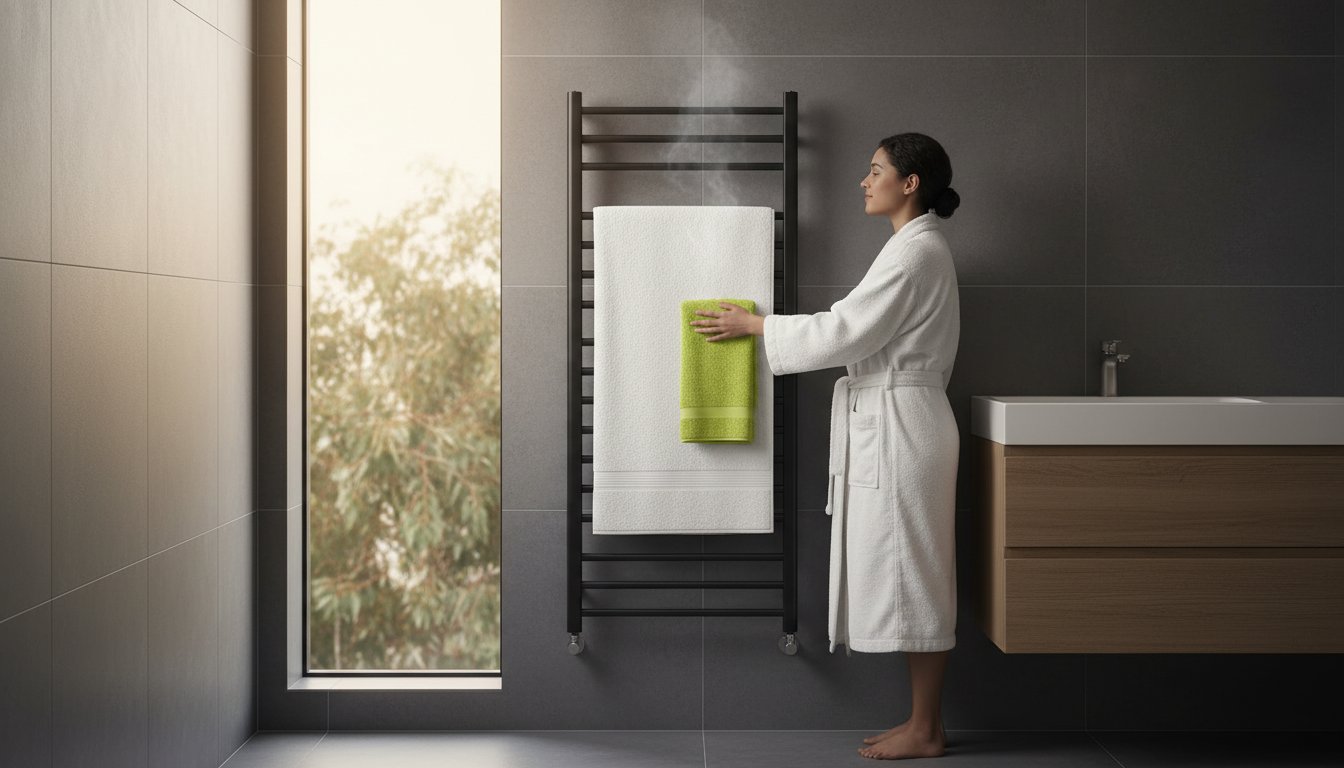
Hydronic towel rails operate as a seamless extension of your home’s sealed wet system. Unlike standard electric versions that rely on dry internal elements, these units utilize hot water circulated directly from your central heat source. High-grade stainless steel or brass rails act as efficient heat exchangers; they capture the thermal energy of the water to radiate consistent warmth. This method is completely silent and avoids the air movement associated with ducted systems, making it a healthier, dust-free choice for Melbourne families.
Achieving peak performance requires more than just plumbing. A professional designer must calculate the specific flow rate and heat output required for your bathroom’s dimensions. According to the energy.gov.au heating and cooling guide, radiant hydronic systems are among the most effective ways to heat a space because they warm objects and surfaces rather than just the air. We use a central manifold to manage these connections, acting as a distribution hub that ensures your towel rail receives the exact pressure it needs without impacting the heat levels in your bedrooms or living areas.
The Heat Pump Connection in 2026
By 2026, the shift toward all-electric homes in Victoria will be the standard for sustainable living. Modern electric heat pumps are now the primary energy source for these systems, replacing traditional gas boilers. While older systems typically ran at 70 degrees Celsius, high-efficiency heat pumps often operate at lower flow temperatures between 45 and 55 degrees. We specify rails with increased surface areas to ensure your towels stay perfectly dry and warm even at these lower, cost-effective temperatures.
Zoning Your Bathroom Comfort
You shouldn’t have to heat your entire house just to dry a single towel after a morning shower. We integrate thermostatic valves that allow your bathroom to function as an independent heating zone. Smart thermostats can be programmed to keep the towel rail active during peak humidity times while the rest of the house remains cool. This targeted approach ensures “always-on” luxury without wasting energy. If you’re looking to optimize your setup, our team can show you how tailored zoning can reduce your total system running costs by approximately 12% to 15% annually.
Hydronic vs. Electric Towel Rails: A 2026 Comparison
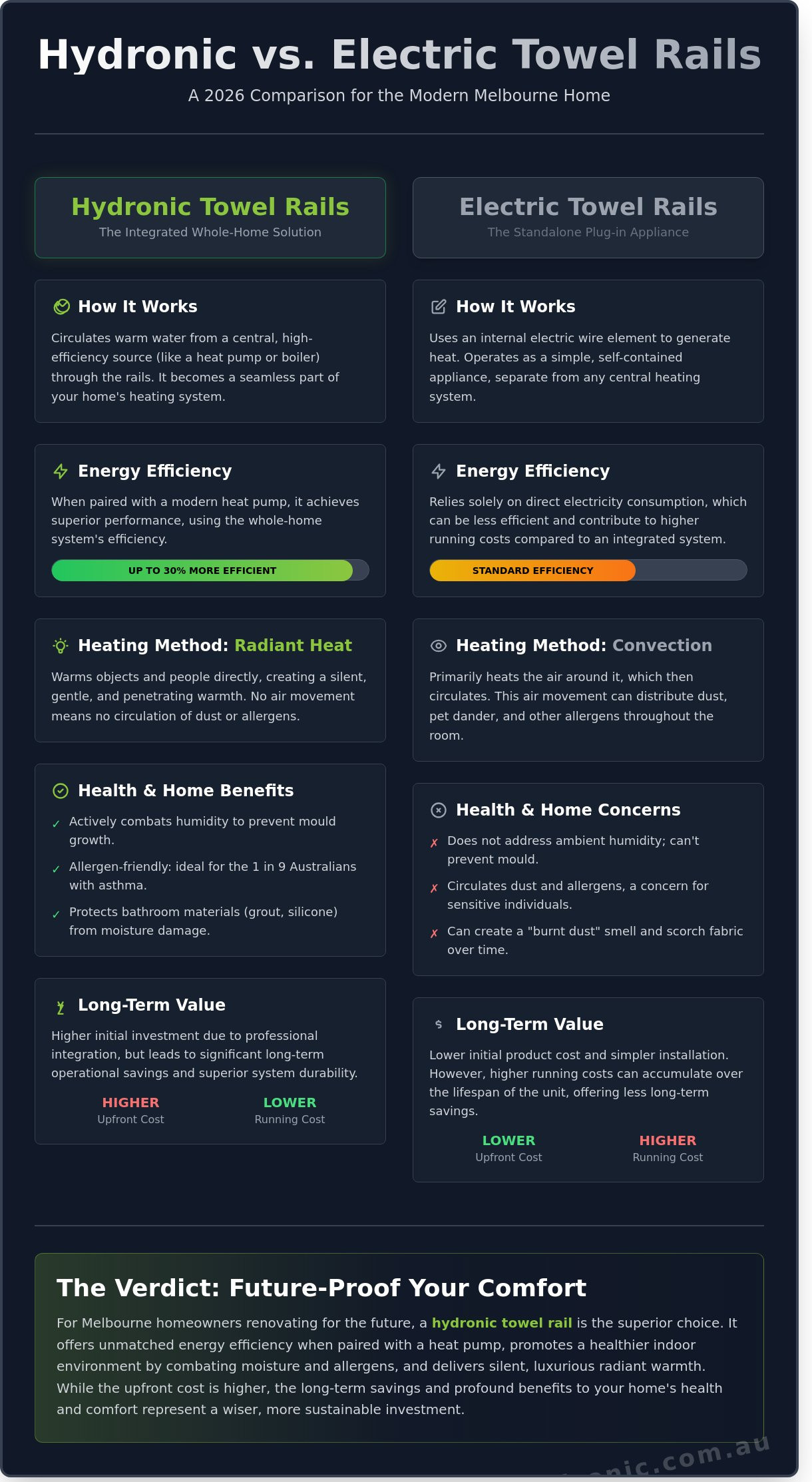
Choosing between heating technologies for your Melbourne bathroom renovation involves more than just aesthetics. While electric rails offer a lower entry price, hydronic towel rails represent a long-term investment in comfort, health, and structural durability. Most electric models rely on internal heating elements or liquid-filled cavities that cycle on and off, often creating “hot spots” that can damage delicate fabrics. In contrast, hydronic systems provide a consistent, radiant warmth that mimics the natural sun, maintaining a stable temperature without the energy spikes associated with electric resistance heating.
Longevity remains the most significant differentiator. High-quality electric rails typically face a component failure within 6 to 8 years as the internal elements degrade. Because hydronic models are essentially specialized plumbing fixtures made from high-grade brass or stainless steel, they often boast a service life exceeding 25 years. They don’t rely on fragile internal wiring, making them a “set and forget” solution for the modern home. Safety is another critical factor for Melbourne families. Hydronic systems operate at lower surface temperatures, significantly reducing the risk of accidental burns for toddlers or the elderly while still providing enough heat to effectively dry heavy bath sheets.
Running Costs and Energy Efficiency
Operating a standard 100W electric rail in Melbourne currently costs approximately A$0.84 per day if left on, totaling over A$300 annually. When you integrate hydronic towel rails into a system powered by a modern air-to-water heat pump, the efficiency gains are substantial. Understanding how hydronic systems work reveals that using a single, high-efficiency heat source for the entire home is far cheaper than running isolated electric elements in every room. For Melbourne homeowners, the ROI of hydronic rails is achieved through a 75% reduction in towel-drying energy consumption and a significantly higher contribution to the home’s overall resale value compared to disposable electric alternatives.
Installation Complexity and Retrofitting
Success with hydronic heating depends on early planning. We recommend finalizing your rail selection during the “rough-in” stage of your build or renovation to ensure pipework is perfectly aligned. It’s often feasible to add a new rail to an existing hydronic radiator circuit, provided the boiler or heat pump has the capacity to handle the additional load. For homeowners considering a complete heating overhaul, our comprehensive radiator heater guide for Melbourne homes explains how hydronic systems can reduce energy consumption by up to 35% when integrated with modern heat pumps. Precision is vital here; our technicians focus on:
- Wall Reinforcement: A water-filled rail can weigh over 18kg, requiring timber noggings for secure mounting.
- Pipe Spacing: Standard 50mm or 150mm centers must be exact to avoid visible wall patches.
- Hydraulic Balancing: Ensuring the bathroom rail receives adequate flow without starving the rest of the house.
By opting for a water-based system, you’re choosing a dust-free, allergen-friendly environment that keeps your towels fresh and your bathroom air healthy throughout the damp Melbourne winter.
Choosing the Right Style and Size for Your Melbourne Home
Selecting hydronic towel rails isn’t just about the look; it’s a technical decision based on your bathroom’s total volume. To keep a standard 6-square-metre Melbourne bathroom at a comfortable 21 degrees Celsius, you generally need a rail providing approximately 400 to 600 Watts of heat output. Unlike noisy fan heaters that stir up allergens, these rails provide a radiant, dust-free warmth that improves indoor air quality. While chrome is a classic choice, 304-grade stainless steel offers superior longevity in high-humidity environments. For those following the 2024 industrial trend in inner-city renovations, matte black or brushed nickel finishes provide a striking contrast against white subway tiles.
Space-saving vertical designs are becoming the go-to solution for compact townhouses in areas like South Yarra or Richmond. These tall, slim units utilise vertical wall space without sacrificing heat performance. If you have a larger floor plan, traditional ladder styles offer the best drying capacity because they allow for multiple horizontal contact points between the warm metal and the damp fabric.
Sizing for Performance
You should match the rail’s scale to your household’s daily needs. A family of four requires a ladder-style rail at least 1200mm in height to ensure every towel dries completely between uses. Larger rails are 15% more efficient at maintaining room temperature because they distribute heat across a broader surface area. Always ensure a minimum 50mm wall-to-rail clearance. This specific gap promotes the essential convection currents that move warm air through the towels, preventing the musty smells often associated with poor ventilation.
Aesthetic Integration
Design preferences in Melbourne vary from the coastal vibes of Bayside to the sleek, modern builds in Cheltenham. Floor-to-ceiling hydronic towel rails have become a hallmark of luxury projects, acting as both a primary heat source and a visual anchor. If you’re aiming for a minimalist look, concealed plumbing hides the pipework within the wall cavity for a seamless finish. Alternatively, exposed copper valves offer a timeless, period-correct feel for renovated Victorian homes in Hawthorn or Camberwell. This choice often depends on whether you’re performing a full “back-to-studs” renovation or a simple fixture upgrade.
If you are planning a full “back-to-studs” renovation, working with a team that can oversee the entire project from design to installation is essential. For expert guidance on complete bathroom transformations, visit WDC Services.
Professional Installation with Melbourne Hydronic Heating
Expertise matters when integrating new components into an existing heating circuit. Since 1994, our team has designed bespoke systems across Greater Melbourne, ensuring that every addition enhances home comfort. Installing hydronic towel rails isn’t a simple “plug and play” task. It requires a deep understanding of hydraulic resistance and flow rates to maintain system integrity. We’ve spent 30 years perfecting this craft, moving beyond basic plumbing to provide high-end engineering for Victorian homes.
Our technicians focus heavily on ‘balancing’ your system. When a new rail is added, it changes the water pressure distribution throughout the entire house. Without precise adjustment, you might find your bedroom radiators underperforming while the bathroom overheats. We use digital manometers to calibrate every valve, ensuring heat is distributed evenly. This technical precision is why we recommend premium European brands. These units are built to withstand Victorian water conditions, featuring internal coatings that prevent the corrosion often seen in cheaper, non-specialised imports.
Our Design and Supply Process
We start by calculating the specific heat load of your bathroom. This isn’t a guess; we factor in room volume, window glazing, and tile types to ensure your rail provides genuine warmth rather than just drying towels. Our partnership with manufacturers ensures we supply 2026’s most efficient rails, which meet upcoming strict energy performance standards. Every Melbourne Hydronic Heating installation includes a 100% leak-free guarantee. We pressure test the new circuit at 1.5 times the standard operating pressure before handover to ensure long-term reliability.
Book Your Melbourne Consultation
The best way to experience the quality of our hydronic towel rails is to see them in action. We invite you to visit our Cheltenham showroom to view our range of finishes and heat outputs. If you can’t make it in, our mobile consultants provide on-site assessments across Bayside, the Mornington Peninsula, and Geelong. We provide a clear, fixed-price quote that covers everything from the initial design to the final system optimisation. Ready to upgrade your bathroom’s comfort? Request a professional hydronic towel rail quote today and let our 30 years of experience work for your home.
Elevate Your Melbourne Home with Sustainable Bathroom Comfort
Choosing hydronic towel rails isn’t just about the luxury of a warm towel on a July morning. It’s a strategic investment in your home’s energy efficiency and long-term health. By 2026, integrating these systems with modern air-to-water heat pumps can reduce bathroom heating energy consumption by 60% compared to traditional 2.4kW electric alternatives. You’ll enjoy a dust-free, silent warmth that eliminates circulating allergens while adding a premium aesthetic to your space.
Melbourne Hydronic Heating brings over 30 years of local expertise to every installation. As a family-owned and operated business based in Cheltenham, we understand the specific demands of the Victorian climate. We’re specialists in energy-efficient heat pump integration, ensuring your system remains cost-effective and environmentally friendly for decades to come. Our team combines three decades of technical precision with a commitment to your family’s comfort.
Upgrade your bathroom with Melbourne’s hydronic heating experts and secure a warmer, healthier future for your home. We’re ready to help you design a system that works perfectly for your lifestyle.
Frequently Asked Questions
Can I install a hydronic towel rail if I don’t have hydronic heating?
You need an existing hydronic heating system, such as a gas-fired boiler or an air-to-water heat pump, to operate a standard hydronic towel rail. These rails function by circulating hot water through a closed-loop pipe network throughout your home. If your property lacks this infrastructure, you might consider a dual fuel model. This hybrid version connects to your plumbing but includes an internal electric element for independent operation.
Do hydronic towel rails provide enough heat to warm the whole bathroom?
Hydronic towel rails can heat an entire bathroom effectively if the unit’s heat output matches the room’s specific dimensions. A standard premium rail produces between 400 and 1,200 Watts of heat, which is sufficient for a typical 6-square-meter Melbourne bathroom. Unlike electric versions that only warm the fabric, these units act as functional radiators. They provide a consistent, dust-free warmth that improves air quality for family members with asthma or allergies.
How much does it cost to run a hydronic towel rail in Melbourne?
Running a hydronic towel rail costs approximately A$0.15 to A$0.25 per day when integrated into a high-efficiency condensing boiler system. This is significantly cheaper than electric alternatives, which can cost upwards of A$0.85 per day at current Melbourne energy rates. Because the water circulates within an existing heated loop, the marginal energy required to maintain the rail’s temperature is minimal. You’ll often see a 60% reduction in towel heating costs compared to standalone electric bars.
Can I replace my existing electric towel rail with a hydronic one?
You can replace an electric rail, but the installation requires running new flow and return pipes from your central heating system to the bathroom. This process involves a licensed plumber and often requires access behind the wall or under the floorboards. While the initial setup is more complex than a simple plug-in unit, the long-term energy savings and superior heat output make it a professional-grade investment for Melbourne homeowners.
What happens to the towel rail in summer when the main heating is off?
Standard hydronic towel rails remain cool during summer because they rely on the central boiler that is typically switched off in warmer weather. To keep your towels dry year-round, we recommend installing a dual-fuel valve kit. This allows you to switch to a 200-watt electric internal element during the humid Melbourne summer. It ensures your bathroom stays moisture-free without needing to fire up the entire home heating network.
Are hydronic towel rails safe for children to touch?
Hydronic towel rails are safe for children because they typically operate at a surface temperature between 45°C and 55°C. This is hot enough to dry towels effectively but won’t cause instant burns like a 240V electric element might. The heat is radiant and gentle, creating a safer environment in high-traffic family bathrooms. Because there are no exposed glowing coils or fans, the risk of accidents is virtually zero.
How long does it take for a hydronic towel rail to dry a towel?
A high-quality hydronic towel rail will thoroughly dry a damp bath towel in 2 to 4 hours. The constant circulation of hot water ensures the entire surface area of the rail remains at a consistent temperature. This efficiency prevents the musty smell often found in damp Melbourne bathrooms during the winter months. By maintaining this heat, the rail also reduces humidity levels, which stops mold growth on your ceiling and walls.
What maintenance do hydronic towel rails require?
Maintenance is minimal and usually involves bleeding the rail once a year to remove trapped air. You simply use a small key to open a valve until water appears, ensuring the rail heats evenly from top to bottom. We also suggest a professional system check every 24 months to monitor the corrosion inhibitor levels in your water. This simple care routine ensures your premium European-style rail lasts for 25 years or more.